How Ultrasound Can Help Extend the Lifespan of Industrial Assets by Revealing Hidden Stress Corrosion Cracking
Introduction: Stress Corrosion Cracking in the Industry
Stress corrosion cracking (SCC) is a well-known damage mechanism that can occur under specific physical and chemical conditions in the oil and gas, chemical, and nuclear industries. While the detection of SCC has become increasingly effective with phased array ultrasound techniques, accurate sizing of such cracks remains challenging, particularly in sound-attenuating and anisotropic materials such as the stainless steels used in the oil and gas and nuclear sectors.
For SCC to develop, three conditions must present simultaneously:
a. Susceptible material
b. A tensile stress environment (e.g., residual stress from welding)
c. A corrosive environment (e.g., chloride exposure)
Elevated temperatures can accelerate the damage formation process.
In the oil and gas industry, SCC in concentrated salt solutions has been associated with several incidents involving offshore structures made of duplex stainless steels, as documented in references (1), (2), and (3). Several studies (4, 7) have investigated SCC in clad pressure vessels used in offshore applications, evaluating different techniques of crack detection and assessment. Figure 1 shows macrographs of transgranular SCC and intergranular SCC in the austenitic cladding layer of a pressure vessel.
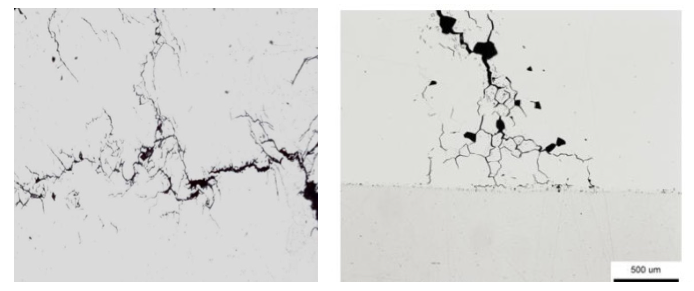
In nuclear power plants, SCC is an important aging degradation mechanism affecting sensitive components in both boiling water reactors (BWR) and pressurized water reactors (PWR). Components made of austenitic stainless steels have been reported to be susceptible to intergranular SCC (4, 5). A factor specific to nuclear environments is exposure to high neutron fluence, which can make stainless steels susceptible to SCC, a phenomenon known as irradiation-assisted stress corrosion cracking (IASCC). In other cases, SCC damage has been reported near welded joints in the safety injection systems of the PWRs (6). Additional information on SCC can also be found in reference (10).
Structure of Typical SCC and Interaction with Ultrasound Beams
Stress corrosion cracking is a complex failure mechanism resulting from the combined effects of tensile stress and a corrosive environment. Understanding the structure and geometry of SCC is essential for effective detection and characterization.
Structure of Stress Corrosion Cracking
SCC typically initiates at the interface where susceptible materials are both exposed to both tensile stress and a corrosive environment. From the surface, cracks propagate into the material as fine, sharp branches, generally oriented perpendicular to the direction of tensile stress. Over time, they may form networks of fine interconnected cracks. As cracks propagate, their tips interact with the material’s grain structure, which often guides their growth.
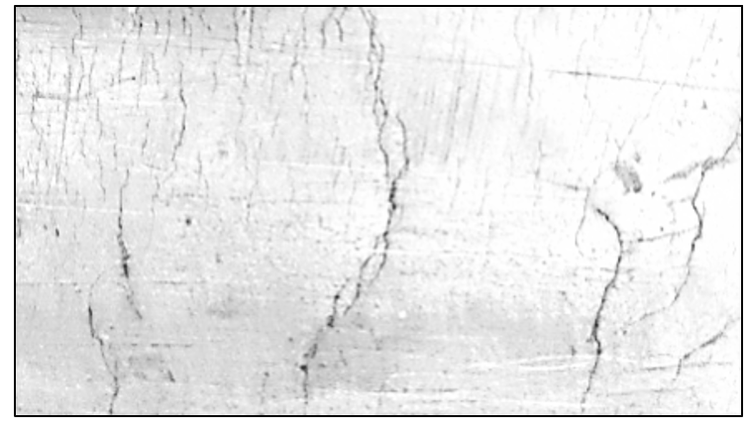
Figure 2 shows an example of a stainless-steel component affected by SCC. A comprehensive theoretical overview of SCC phenomena in various materials can be found in reference (8).
Detection of Stress Corrosion Cracking
Although SCC in an advanced stage may sometimes be visible on the surface, the characteristic morphology—fine branches and narrow crack tips extending within the material—makes visual assessment unreliable and insufficient for nondestructive evaluation.
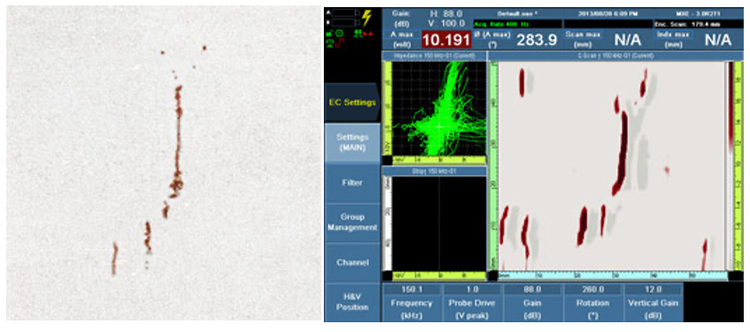
Nondestructive testing (NDT) methods such as liquid penetrants or eddy current array (ECA) inspection are commonly used to evaluate surface-breaking cracks by detecting crack openings (Figure 3). However, the deeper crack tips, branches, and networks are typically assessed using ultrasonic inspection techniques.
Ultrasound beams with appropriate wave frequencies can propagate through the material and detect clusters of cracks or individual crack features such as the base, branches, or tips. This capability enables crack characterization, including surface connectivity, orientation, and depth.
An example of phased array ultrasonic data is shown in Figure 4 (4). The upper echo represents a crack tip or upper branch extending into the material, while the base echo is likely generated by sound trapped in the corner formed by the crack base and the back wall of the component. Measuring the time-of-flight between these two echoes provides an estimate of the crack height.
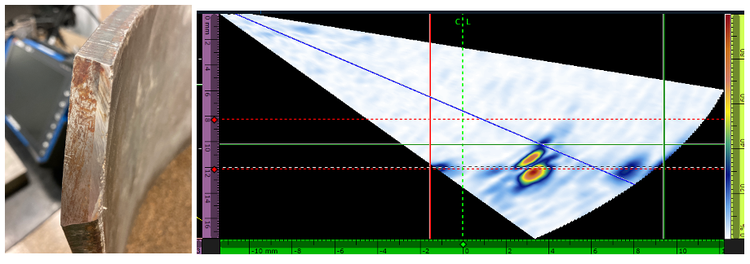
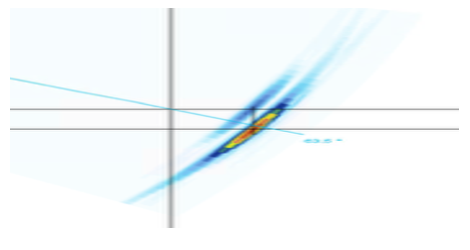
Figure 5: Simulation of interaction of shear sound beams with a vertical notch. A weak echo is generated (diffracted) by the top of the notch while a much stronger signal is reflected at the notch base
Sound Interaction with a Vertical Notch
A simplified model frequently used to evaluate ultrasonic responses from cracks is a vertical notch. Vertical notches are commonly used as sensitivity calibration references for inspection methods targeting vertical or near-vertical flaws.
Generally, the expected response from a vertical flaw connected to the back wall is a strong echo from the corner “trap”, or the base of the flaw, and a weaker (diffracted) signal from the tip of the flaw. An example is shown in Figure 5, where a simulated beam interacts with a simple vertical notch. Two main echoes are clearly visible: a low amplitude diffracted echo from the top of the flaw and a stronger echo reflected from the corner formed by the notch base and the back wall.
Techniques and Their Potential: TOFD, PA, TFM, PCI
Several advanced ultrasonic imaging techniques can be used to inspect vertical flaws:
- Time-of-Flight Diffraction (TOFD). TOFD is highly sensitive to small discontinuities such as crack tips, flaw edges, and porosities, and it is widely used for weld inspection. However, TOFD is less suitable for metal structures affected by extensive SCC networks because its two-probe configuration limits its ability to produce two-dimensional mapping.
- Standard Phased Array Ultrasonic Testing (PAUT). Phased array inspections typically use shear or longitudinal waves transmitted at multiple angles through a sectorial scan directed towards the suspected flaw.
- Total Focusing Method (TFM). TFM produces focused beams at every point within a defined region of interest. Operators can select different sound paths or beam sets for the inspection zone. A direct pulse-echo configuration produces an image similar to a phased array sector scan but with improved coverage and focusing.
- TFM Self-Tandem Mode. In this configuration, the ultrasonic beam reflects from the back wall, then from the side of the flaw, before returning to the probe. This method can reproduce the vertical geometry of the notch more accurately.
- Phase Coherence Imaging (PCI). PCI is a more recent imaging technique that relies on the phase coherence of reflected signals. It is particularly effective at enhancing diffracted signals while reducing sensitivity to large specular reflectors.
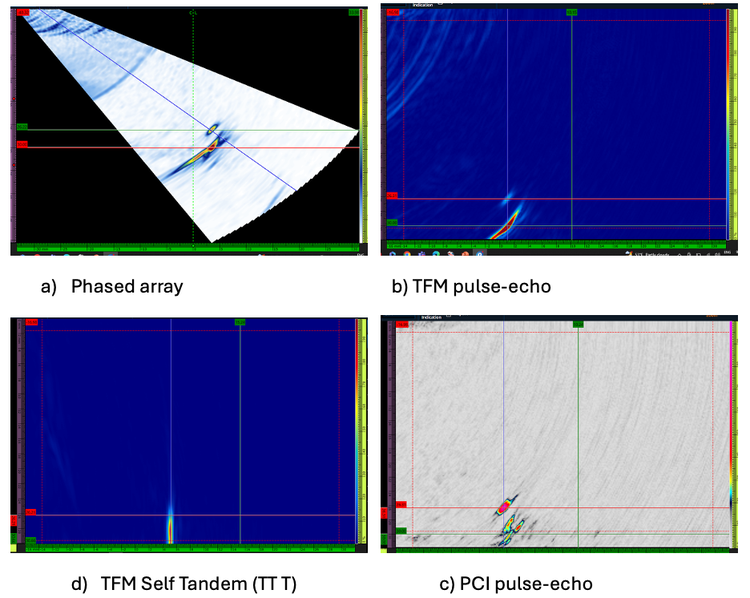
Figure 6 illustrates the response of a vertical notch using these four imaging techniques.
- Figure 6 a) Phased array sectorial scan data of a real notch in a steel plate. A weak diffracted signal from the tip and a much stronger corner-trap echo are visible.
- Figure 6 b) TFM pulse-echo data from the same vertical notch. With focusing at all points in the zone of interest, both features—the tip and the base—are easily distinguished with very good resolution.
- Figure 6 c) PCI data from the same zone of interest as in the TFM data. PCI enhances the diffracted echo from the tip and minimizes the echo from the base. It can provide better near-backwall resolution for cracks that extend only a few millimeters from the back wall, as well as improved detection of tips or small branches.
- Figure 6 d) TFM data in self-tandem mode (TT T). It reproduces a real-life view of the notch.
All these methods allow crack height sizing by measuring the time-of-flight between the tip echo and the base corner echo).
Complex Crack Morphology – Ultrasonic Interaction with SCC Tips and Branches
In practice, SCC is far more complex than a simple notch. It often consists of clusters or networks of interconnected cracks with multiple bases and branches. Small corners within this network may reflect ultrasonic waves if oriented towards the incoming sound beam. In addition, the furthest branches and their tips may become tighter with depth and extend to the material’s grain level. These tips are likely very difficult to detect using ultrasound.
Another important parameter is crack origin and orientation. Depending on the stress source and direction, SCC can originate at the outer surface (OD-connected cracks) or at the inner surface (ID-connected cracks). With regard to exposure to ultrasonic beams used for inspection, ID-connected cracks have tips exposed to a direct wave, whereas OD-connected cracks may expose branches, providing indirect and more limited access to their tips.
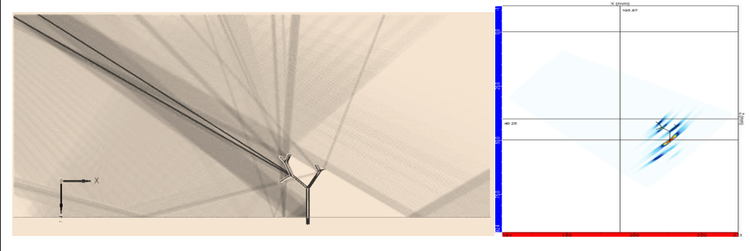
To better understand the complexity of how sound waves interact with cracks, simplified crack models and sound beam simulations can be used. Figure 7 shows a simplified crack model and the result of a sound beam incident on its tips and corners. The beam is scattered in all directions by the crack corners and branches. Mode conversions are also likely to occur, making data interpretation more difficult (conversions are not displayed in this case).
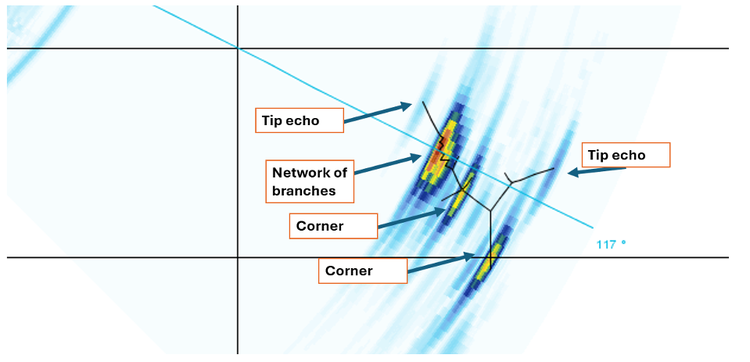
A key characteristic of discontinuities that are considerably smaller than the incident wavelength is diffraction. Diffracted waves are generated at crack tips or small corners and propagate in all directions. Diffracted signals are usually weaker than echoes from corners and branches. Distinguishing crack tips and branches from the base may require higher resolution, meaning higher-frequency beams. Figure 8 shows a magnified sectorial phased array scan of a simulated crack with a long branch, a tip, and multiple small corners. In this case, weak tip diffractions can be separated from echoes from branches and corners due to the shorter wavelength (10 MHz, transverse waves) and the greater separation distance between tips and branches. An important observation is that even tips not oriented towards the incoming beam can still produce diffracted echoes, whereas some branches outside the beam path may not produce any reflection.
Beam Optimization. How to Choose the Right Setup to Increase the Detection Probability of SCC
Phased array offers a wide variety of parameters to consider when planning an SCC inspection project. Table 1 provides a comprehensive, though not exhaustive, list of parameters along with their benefits and drawbacks for SCC inspection.
As is often the case with phased array, when selecting the appropriate probe, the application must be considered, including material type, flaw type and geometry, as well as detection and sizing requirements. Very often, the most suitable solution dictated by the material conflicts with the detection requirements.
For example, thick or coarse grain materials typically requires a larger aperture, larger probe elements, lower frequency, and possibly longitudinal-wave linear probes or even TRL. Conversely, detecting small cracks, tips, and branches requires high resolution and divergent beams, thus higher frequency, smaller probe elements, and longitudinal waves. In such cases, compromise becomes key.
Table 1 lists the phased array probe parameters and methods, along with their benefits and drawbacks for SCC detection.
Table 1 List of parameters to consider when planning an SCC inspection. (+) benefits; (-) limitations
| Probe type | Linear | Dual (TRL) | Matrix | |
| Benefits | Easier deployment; high availability | Better SNR with low profile wedge and T/R separation | Better beam focusing in both planes if aperture large enough, beam skew | |
| Limitations | Potentially reduced SNR and large wedge | Geometrically focusing = limited zone for high sensitivity | Limitations due to pulse-echo configuration = Lower SNR than TRL | |
| Frequency | Low (e.g., 2.25 MHz) | High (e.g., 10 MHz) | ||
| Benefits | Deeper penetration | High attenuation | ||
| Limitations | Low resolution | Best resolution | ||
| Aperture | Large | Small | ||
| Benefits | Best for deep crack inspections | Best for low-thickness materials | ||
| Limitations | ||||
| Element size | Large | Small | ||
| Benefits | Directive beams; high energy | Better sensitivity to diffracted signals; better steering | ||
| Limitations | Less divergence, steering power, and sensitivity to diffracted signals | Lower energy, less penetration power | ||
| Wave mode (wedges) | Shear | Longitudinal | ||
| Benefits | Better resolution | Better sensitivity to diffraction; deeper penetration | ||
| Limitations | Less diffraction and penetration | Generation of additional T modes; lower resolution | ||
| Technique | PA | TFM | PCI | |
| Benefits | Easier to deploy and standardized; high sensitivity in the focal area | Focusing at all points of the zone of interest; wider coverage | Does not require correction for attenuation; similar sensitivity in all points and less dependency of crack tips and orientation | |
| Limitations | Less coverage and limited focusing due to a reduced zone | Requires amplitude correction for attenuation; hard to calibrate sensitivity for cracking | Not yet standardized; difficult to calibrate for sensitivity | |
The following figures provide examples of use cases for three imaging techniques used for the detection and sizing of cracking areas.
Figure 9 presents the TRL technique. A dual probe uses one element to transmit the signal and the other to receive it while generating longitudinal waves in the inspected part. A characteristic of dual probes is beam crossing, which produces a pseudo-focal region at the intersection of the transmitted and received beams. This focusing enhances sensitivity to crack tips in the area of beam intersection. The downside of using longitudinal waves is the additional generation of shear waves (SW), which travel at a lower velocity and create additional echoes that are difficult to identify as originating from shear waves.
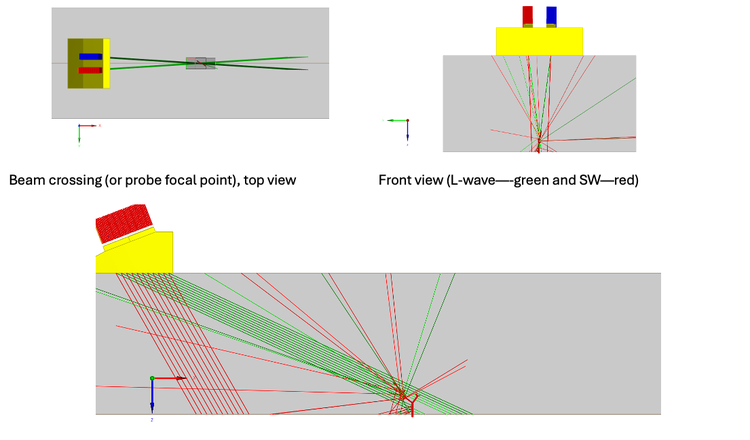
Figure 10 displays an example of a phase coherence image of a crack overlaid on a photograph of a section of the inspected sample. This display provides a simplified explanation of how phase coherence imaging works and how ultrasonic waves interact with cracks. In this example, the red and yellow indications are PCI diffracted signals corresponding to crack tips and branches located on the same side as the phased array probe. It also shows that the sound is blocked by the first branches encountered in its path and therefore cannot reach more distant branches.
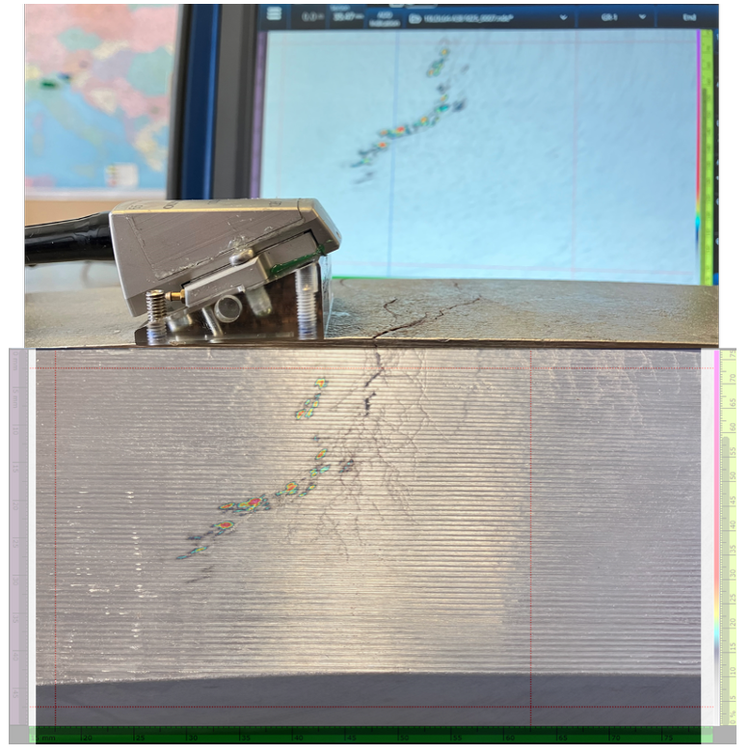
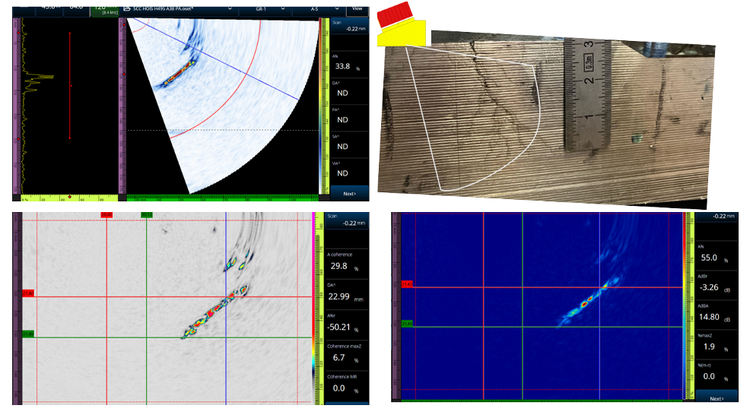
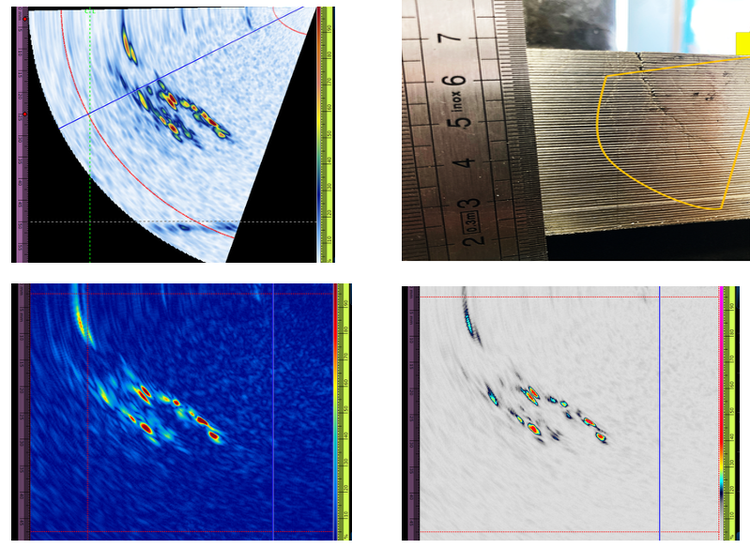
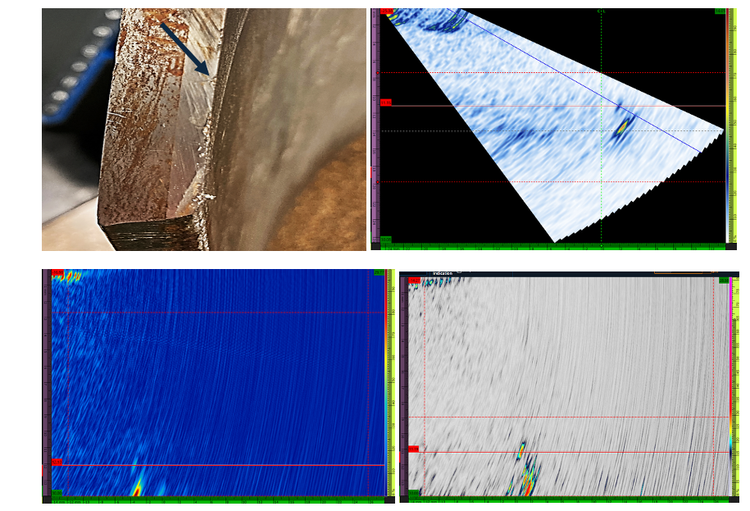
Figure 11 and Figure 12 present data acquired using three techniques: PA, TFM, and PCI, with a dual 10 MHz probe. The data was acquired on thick (50 mm) stainless steel structural components. The cracks initiate and open at the surface (OD) and propagate in depth. The challenge is to detect the deepest crack tip and report its depth. In all cases, the crack is only visible when located in the direct path of the sound generated by the PA probe. When the crack is hidden or shadowed by others, only a full skip from the back wall can provide a chance of detection. When comparing the three techniques, the following observations can be made:
- TFM and PCI cover a wider inspection area than phased array.
- In phased array, sensitivity depends on the selected focal plane, while TFM provides focusing at all points in the area of interest.
- PCI provides similar sensitivity at all points; its SNR is not influenced by sound attenuation, crack tip position, or orientation. Similar sensitivity is obtained along the crack for all tips.
The last case presented in Figure 13 shows how the height of a crack in a cladding layer can be measured using the time-of-flight diffraction method. In the amplitude-based techniques (PA and TFM), the tip echo is weak, while a strong echo is captured from the base of the crack (corner trap). In the phase-based technique (PCI), the diffracted tip echo is enhanced, while the corner-trap echo from the base of the crack exhibits lower sensitivity. By using two of the above methods (one of phase-based and one amplitude-based), this type of crack can be measured and classified (crack connected to the back wall or isolated inclusion).
Conclusion: Choice of Technique and Probe, Limitations of Ultrasound
Detection, classification, and sizing of stress corrosion cracking defects can be challenging under field conditions due to their complex morphology, which includes a multitude of tips and branches with random orientations. This makes interaction with ultrasonic beams and their interpretation more complicated than the detection of more standard flaws (delaminations, lack of fusion, porosities, etc.).
It has been shown through experimental ultrasonic data and simulations that, in the case of cracking, the ultrasonic beam interacts mainly with crack features such as tips, branches, and branch connections or corners. The way beams interact with these features varies significantly, from strong amplitude echoes generated by corners and large branches to weak diffracted waves generated by tips and small branches. With this in mind, the phased array probe used to generate and detect ultrasound in the inspected part should exhibit at least the following properties:
- Capable of generating divergent waves (to cover also the top area at high angles)
- Sensitive to diffracted signals (small elements)
- Able to generate short wavelengths for high sensitivity to tips (high frequency)
- Able to generate high-energy focused beams to penetrate attenuating materials (dual probes)
Regarding the imaging technique, it must be capable of enhancing low-amplitude diffracted echoes while simultaneously detecting high-amplitude corner-trap echoes.
The present study identified solutions based on, but not limited to, longitudinal waves generated by high-element count probes in a TRL (transmitter-receiver longitudinal) configuration, providing enhanced focusing and improved penetration, along with small element size and relatively high frequency (as permitted by the material structure). It also showed that an amplitude-based technique such as sectorial phased array or TFM should be used in combination with a phase-based technique such as PCI (or TOFD where applicable). Together, these techniques improve flaw characterization through the detection of both corners or bases and tips or smaller branches.
References
[1] HSE Offshore Division Safety Notice 3/3003, Issue data: Dec. 2003;
[2] R. Mack, C. Williams, S. Lester and J Cassava, ‘Stress corrosion cracking of a cold worked 22 Cr duplex stainless steel production tubing in a high density clear brine CaCl2 packer fluid’, Paper No. 02067, Corrosion 2002, Denver, NACE Int., Houston, TX., 2002;
[3] NPL REPORT, DEPC MPE 008, Stress Corrosion Cracking of Duplex Stainless Steels in Concentrated Brines – A Critique of Testing
[4] HOIS Recommended Practice NII of Pressure Vessels – HOIS RP-103, February 2020
[5] IAEA Nuclear Energy Series: Stress Corrosion Cracking in Light Water Reactors: Good Practices and Lessons Learned
[6] ASN REPORT on the state of nuclear safety and radiation protection in France in 2022
[7] HOIS Guidance on NII of clad vessels, HOIS-G-026 Issue 1, September 2020, https://esrtechnology.com/hois/
[8] Raja, V. S., Shoji, Tetsuo., Stress corrosion cracking : theory and practice, Oxford, Philadelphia : Woodhead Publishing Ltd, 2011.
[9] Acknowledgments for sample to HOIS Joint Industry Project: https://www.esrtechnology.com/index.php/services/non-destructive-testing-good-practice/hois-ndt
[10] Pauline Huguenin. Amorçage des fissures de corrosion sous contrainte dans les aciers inoxydables austénitiques pré-déformés et exposés au milieu primaire des réacteurs à eau sous pression. Autre. Ecole Nationale Supérieure des Mines de Paris, 2012. Français. NNT : 2012ENMP0069. pastel- 00818372

Florin Turcu
Application Specialist
Florin joined Evident Europe in 2014 as an Application Specialist in advanced ultrasound technologies like phased array and guided waves. With a degree in Physics and a Ph.D. in NDT-related engineering, Florin’s background includes 9 years in research and development in the field of guided wave ultrasonics.