Aluminum Die-Casting Analysis with Vanta Max
Background
Aluminum die casting alloys are widely used as a material for industrial components, as they can produce highly precise parts with complex geometries and are well suited for high-volume production. Their use is particularly significant in the automotive industry, where components require both strength and lightweight properties, including many parts for engines and transmissions. They can also used in electronic devices such as personal computers and mobile devices, as well as home appliances and leisure products.
Manufacturing facilities that produce parts using die-casting materials are found worldwide.
Common aluminum die casting alloys are A380, A383, AA360, B390 or A413 (ASTM standard). The A383 (ASTM), known as well in Japan as ADC12 (JIS), an aluminum–silicon–copper (Al–Si–Cu) alloy, is commonly used for automotive engine components, bicycle parts, and power tools.
These alloys are designed by adjusting the concentrations of alloying elements to achieve desired mechanical properties such as machinability and corrosion resistance. Silicon for example enhances castability, fluidity, and wear resistance while lowering shrinkage defects and copper increases strength and hardness.
Therefore, accurate control of composition is critical in preventing quality issues or material mix-ups during production.
Problem being solved
In many automotive manufacturing facilities, analysis of ADC12 or equivalent alloys is performed using laboratory-based instruments such as ICP or optical emission spectrometers (OES).
These instruments require time-consuming sample preparation and cannot perform nondestructive measurements. As a result, real-time quality control during the casting process is often difficult, creating a need for a faster, simpler, and nondestructive alternative.[TI1]
Description of our Solution
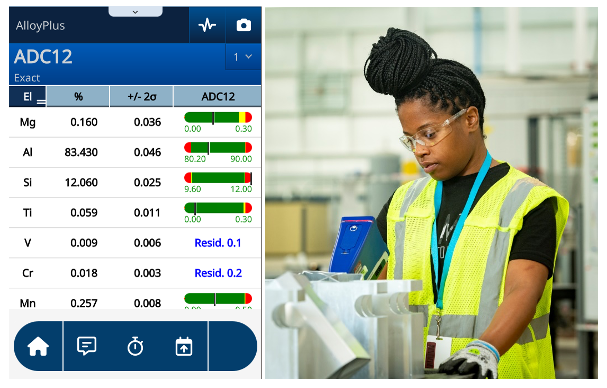
Evident Vanta Max(V2MR) Handheld XRF Analyzer, thanks to Evident proprietary Axon electronic design, rhodium X-ray tube and large graphen Silicon Drift Detector enables repeatable and rapid, nondestructive analysis of ADC12 [DB2]
It can accurately measure key alloying elements such as Si, Cu, Zn, and even low Mg concentrations (<0.3%) with high sensitivity — performance that is difficult to achieve with other handheld XRF instruments[DB3] [DB4] .
Table 1: Limit of detection in Aluminum grade in ppm (60sec per beam)
This allows immediate on-site verification of alloy composition, improving efficiency and reducing costs in manufacturing.
Typical analysis is completed within tens of seconds, offering a significant reduction in inspection time compared with traditional methods.
Discussion of limitations
To accurately measure ADC12 material, it is necessary to measure the machined surface that has not been treated.
Note: Measuring the cast surface treated with a silicon-based release agent may result in higher detected levels of Si.
Conclusion - summary
Vanta Max provides a fast, nondestructive, and high-precision solution for analyzing ADC12 and equivalent Al–Si–Cu die-casting alloys.
This enables real-time verification of alloy composition in automotive manufacturing, improving quality control and efficiency, and allowing in-process inspections that were previously difficult with conventional methods.
Note: As the flagship model, the V2MR has a magnesium detection limit of 780 ppm, enabling accurate analysis of ADC12 samples containing low levels of Mg.