Customer Q&A: How American Magic Uses Phased Array NDT to Inspect High-Performance Composite Boats


Introduction
High-performance composite boats demand precise manufacturing and rigorous inspection. For American Magic, non-destructive testing (NDT) is a critical part of ensuring structural integrity, safety, and performance.
In this customer Q&A, Alek Nilsen, Manufacturing Engineer and Level II-certified NDT inspector at American Magic, shares how the team uses phased array ultrasonic testing (PAUT) to inspect large composite structures, respond quickly to unexpected damage, and reduce operational downtime, and obtain inspection results fast enough to keep the sailing team on site rather than sending them back home.
Q: Can you briefly introduce American Magic and its focus today?
A: American Magic was founded in 2017 with the goal of competing for the America’s Cup. Today, our operations are centered in Pensacola, Florida, which serves as our primary engineering and manufacturing hub.
We focus on designing and building high-performance composite structures for marine and related industries, while maintaining continuity in engineering expertise between competitive sailing campaigns.
Q: What is your role at American Magic?
A: My background is in structural and manufacturing engineering, with a strong focus on composite materials. I work closely with design, production, and engineering teams to translate structural designs into manufacturable components.
I am also responsible for overseeing non-destructive testing activities. As the only Level II–certified NDT inspector on site, I conduct inspections and collaborate with engineers and managers to interpret results and support decision-making.

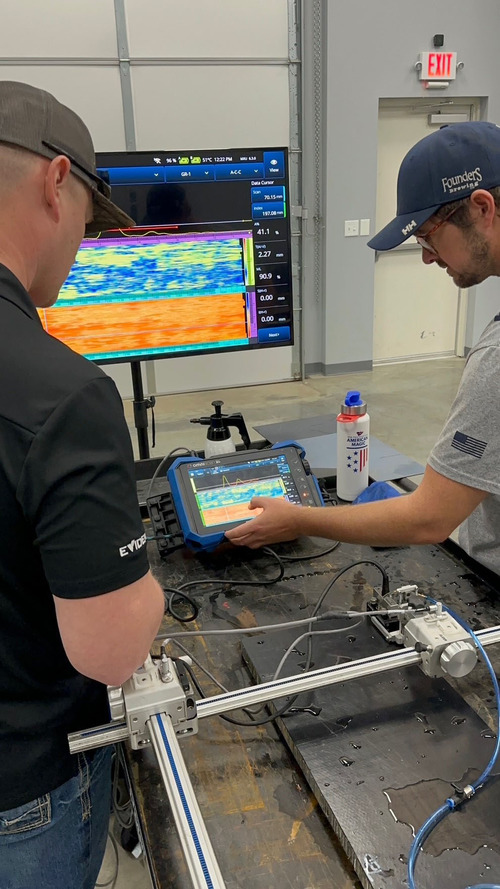
Alek Nielsen explores composite inspection solutions at the Evident Houston laboratory.
Q: Why is PAUT important for composite boat inspection?
A: PAUT is essential for both quality control and operational assessments. During manufacturing, it helps us verify laminate quality and identify issues such as porosity or delamination.
After sea trials or unexpected events, such as a lightning strike, phased array NDT allows us to assess structural condition quickly and accurately, which is critical in high-performance sailing where safety margins are intentionally low.
Q: Why did American Magic decide to bring NDT capabilities in house?
A: Previously, we relied on external inspection providers, often requiring international travel and advance scheduling. While effective, that approach introduced delays and additional cost.
By developing in-house NDT capability, we can perform inspections immediately, reduce downtime, and make faster, more informed decisions when issues arise.
Q: What NDT equipment do you use to inspect large composite structures?
A: We use the OmniScan™ X4 flaw detector with phased array probes, along with the RollerFORM™ XL scanner. This setup allows us to efficiently inspect large carbon fiber structures while maintaining the resolution needed for detailed flaw characterization.
The combination is especially effective when working with complex composite geometries and large surface areas.
Q: How does phased array NDT improve inspection speed and decision-making?
A: Clear ultrasonic imaging is critical when inspection results need to be communicated quickly to engineers and managers who may not be NDT specialists.
The clarity of phased array data helps us identify indications with confidence and reduces the time required to interpret results and decide on next steps.
Q: Can you share an example of where in-house NDT made a significant impact?
A: After a recent sea trial, we encountered unexpected structural damage. Because we had PAUT equipment on site, we were able to assess the extent of the damage immediately.
The inspection showed that the damage was more extensive than initially assumed, allowing us to halt operations and plan appropriate repairs based on reliable data.
Q: How frequently do you perform NDT inspections?
A: Inspection frequency depends on the project, but during active manufacturing or testing phases, PAUT may be performed several times per week or even daily.
High-performance boats experience significant loading, so routine inspection is an essential part of ongoing operations.
Q: How has your experience been working with the Evident team?
A: It's been awesome! It was a huge selling point for me because communication is so good between us and the Evident team. I don’t like talking too much, but when I do, you guys are pretty much onto it right away. And the whole time I spent in Houston was super good! Short amount of time, but very effective.
As an example, by the time we got quotes from another NDT equipment company, your Sales team was here doing demos and showing equipment. Your response was really quick, and it felt good, especially with us being reaction-based decision makers. The day is always different for us, so having somebody that has a similar cadence was refreshing. We are happy with everything! Your presence and support made it an easy choice over the competition.
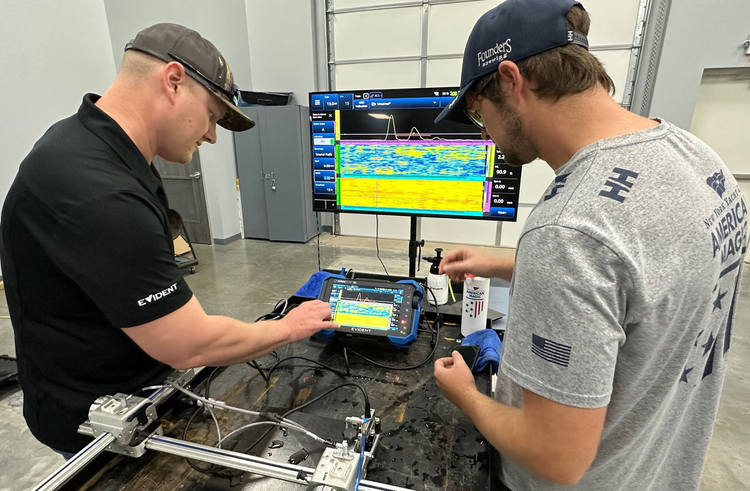
An Evident Application Engineer team member demonstrates a composite inspection solution during an on-site session—“Your presence and support made it an easy choice over the competition.”
Q: How do you see your composite NDT capabilities evolving in the future?
A: As our manufacturing activities expand, NDT will become even more integrated into daily workflows. PAUT will continue to play a central role in supporting quality, safety, and performance.
Conclusion
By bringing PAUT in house, American Magic has strengthened its ability to inspect high-performance composite structures, reduce downtime, and support confident decision-making.
This customer experience demonstrates how Evident advanced NDT solutions can support organizations working with large, complex composite components in demanding environments.