Comparing PAUT, PWI, PCI, and TFM Technologies

Stephan Couture
June 10, 2025
A versatile, multitechnology solution, every model of the OmniScan X4™ flaw detector is fully equipped with every ultrasonic testing (UT) techniques we have to offer:
- Conventional UT
- Phased array ultrasonic testing (PAUT)
- Time-of-flight diffraction (TOFD)
- Total focusing method (TFM)
- Phase coherence imaging (PCI)
- Plane wave imaging (PWI)
- Twin TFM/PCI
The combination of these advanced imaging capabilities and an easy-to-use interface enables OmniScan X4 users of all skill levels to perform rapid, reliable inspections of welds and components.
Our aging infrastructure can be affected by complex damage mechanisms such as high-temperature hydrogen attack (HTHA), hydrogen sulfide (H2S), and creep damage. These flaws are particularly challenging to detect with only conventional UT or PA because of inherent limitations to do with the sound beam and the shape, size, and angle of the damage. It’s an advantage to be able to exploit different techniques and tools to properly discern them.
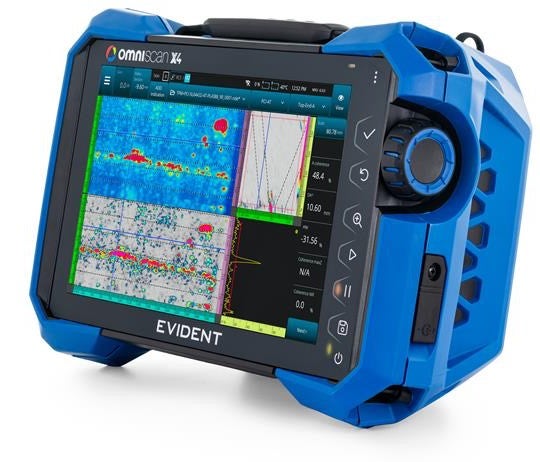
All OmniScan X4 models (including the 16:64PR) offer TFM, PCI, PWI, and twin TFM/PCI capabilities in addition to UT, PAUT, and TOFD.
But which technique is best for which type of flaw? FMC, TFM, PCI, and PWI are relatively new on the NDT scene—even experienced phased array practitioners may be unfamiliar with some of these new ultrasonic technologies. Rather than tell you about them, I decided to show you. To try and help demystify TFM, PCI, and PWI, I performed a few imaging experiments on standards containing a typical weld flaw, i.e. lack of root penetration (LORP), and HTHA damage.
What Is the Difference between TFM, PCI, and PWI?
Before we take a look at imaging comparisons, I’ll recap how each imaging technique works in general terms:
- FMC: A pulse-receive sequence designed to acquire a comprehensive set of waveform data from a single phased array (PA) probe. The sequence involves pulsing one element at a time while receiving on all elements. This process is repeated until each element in the array has been individually pulsed.
- PWI: A pulse-receive sequence that captures a reduced volume of waveform data compared to FMC. In this method, multiple-element apertures are pulsed and signals are received on all elements. The process is repeated until all user-defined beams have been collected.
- TFM: The data collected from each transmitter-receiver combination, whether using FMC or PWI, is processed using delay-and-sum algorithms to generate a "focused everywhere" image. Synthetic beamforming is applied in both transmission and reception by synthesizing all combinations of elementary transmission and reception data (A-scans) acquired.
Watch our video on the basic principles of TFM on the Inspectioneering website.
- PCI: An amplitude-free variation of TFM, phase coherence imaging uses FMC data but only the phase information is conserved, and the amplitude is discarded. An image is then generated based on the level of phase coherence between A-scans, rather than the summed signal amplitudes. Phase coherence is assesed by analyzing the frequency distribution of the A-scans.
Weld Inspection Comparison: PAUT vs. FMC vs. PWI
In the first comparison, I generated images using three different technique combinations. Here are the parameters I used:
- PAUT: Compound scan 40° to 70° with a 0.5° step
- FMC using TFM and PCI: T-T mode with double thickness zone (full matrix and sparse configuration)
- PWI using TFM and PCI: T-T mode with double thickness zone (angles 40° to 70° with varying angle steps)
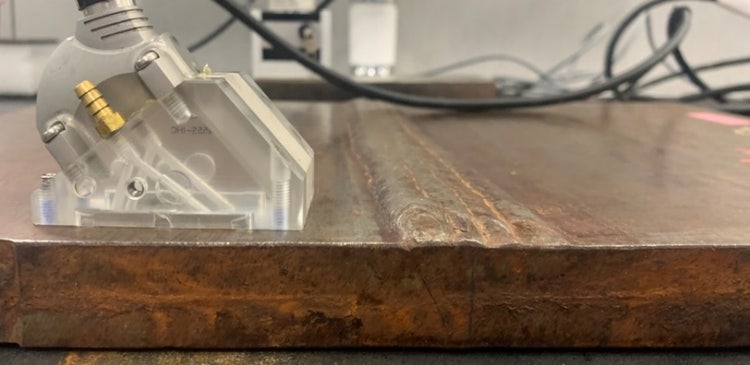
Our first test configuration is a single V weld with a 25.4 mm thickness. Tests were conducted using a 5L64 A32 probe with N55S wedge.
Amplitude Data
To compare the PAUT, FMC, and PWI amplitude data, optimal scan parameters were used: “full sparse” FMC and an angle step of 1° for PWI. For this comparison, the lack of root penetration (LORP) tip signal was normalized to 80%.
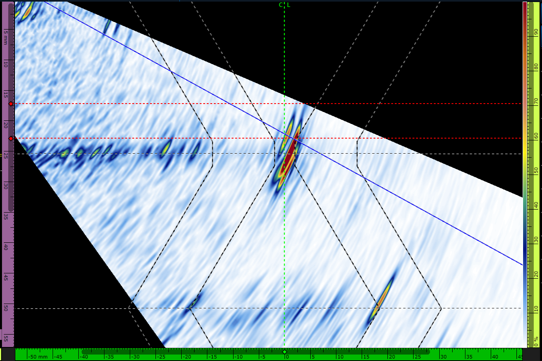
PAUT scan speed: 132 mm/s
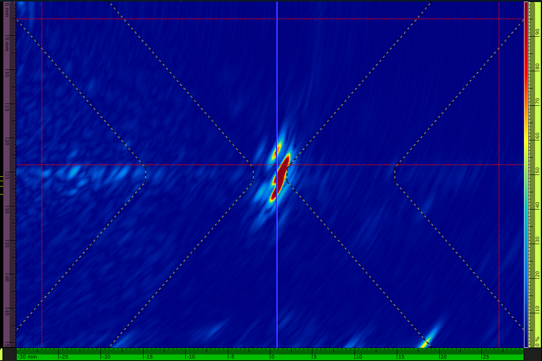
FMC/TFM max scan speed: 18 mm/s
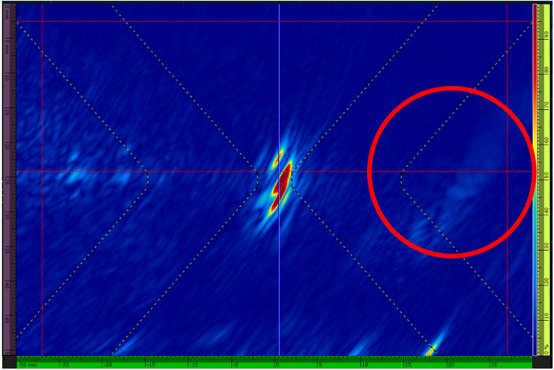
PWI/TFM max scan speed: 38 mm/s
We see here that signals are comparable between the different technologies. PWI shows an unwanted echo beyond the inspection area (circled in red). PWI enables a scanning speed of roughly two times that of FMC. However, the PAUT results are just as good, and its inspection speed is significantly better.
Phase Data
Using the default PCI color palette, PWI/PCI returns a noticeably weaker signal than FMC/PCI. When the color palette is adjusted (zoomed), however, PWI/PCI shows a noisier signal and also shows that all of the aspects of the indication are still detected.
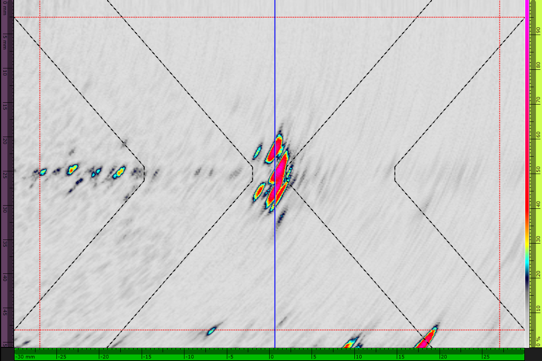
FMC/PCI max scan speed: 17 mm/s
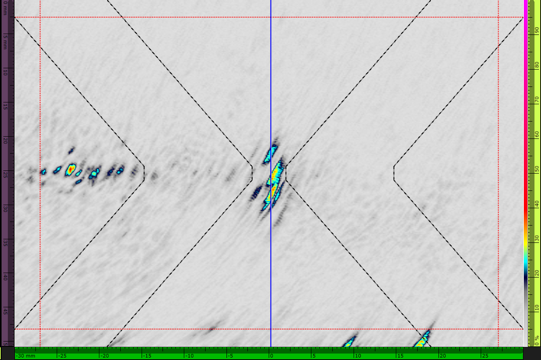
PWI/PCI max scan speed: 35 mm/s
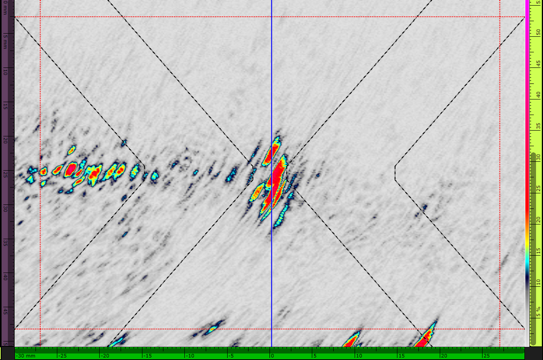
PWI/PCI max scan speed: 35 mm/s (with color palette adjusted)
We see here that while PWI enables a faster scanning speed, there is a significant trade-off in signal quality, with the quality worsening as the speed increases.
Amplitude: Sparse
For the next set of images, I used the “Sparse 1/2” firing setting. This impacted the noise level for the flaws: for the LORP, the signal-to-noise ratio (SNR) went from 30.8 dB to 29.4 dB; and for the toe crack, the SNR went from 25.6 dB to 23.1 dB.
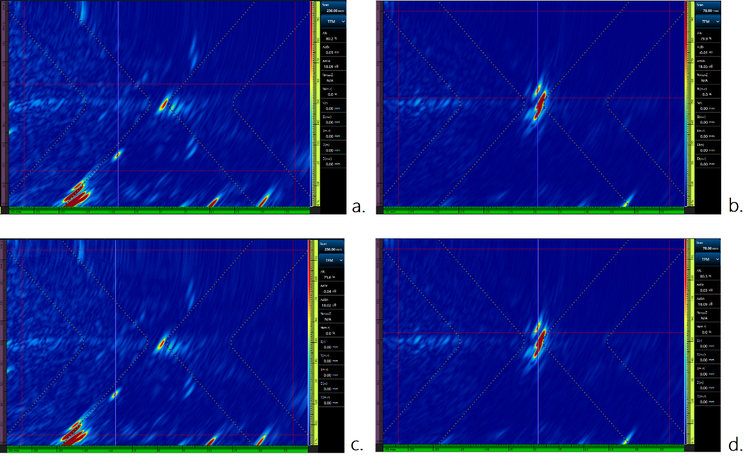
FMC/TFM Full Matrix max scan speed: 18 mm/s (a and b), FMC/TFM Sparse 1/2 max scan speed: 36mm/s (c and d)
We see here that scanning speed with Sparse 1/2 is equivalent to PWI with a 1° angle step and without the unwanted signal drawback.
Amplitude: Limited PWI Angles
In comparison, we see a rapid decrease in signal quality as the PWI angle step is increased.
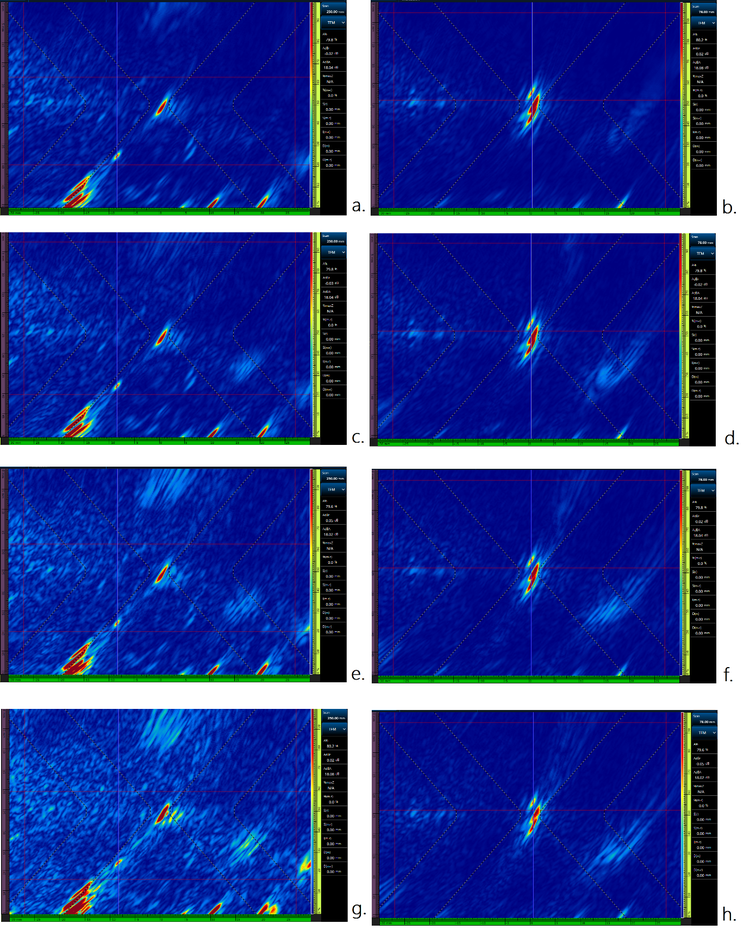
PWI/TFM 1° angle step max scan speed: 38mm/s (a and b), PWI/TFM 2° angle step scan speed: 73mm/s (c and d), PWI/TFM 3° angle step scan speed: 106mm/s (e and f), PWI/TFM 5° angle step scan speed: 167mm/s (g and h)
HTHA Inspection Comparison: PAUT vs. FMC vs. PWI
In our second technique comparison, we’ll take a look at inspection images created using three different technique combinations and parameters:
- PAUT: 0° linear scan using a 40-element aperture
- TFM and PCI using FMC: L-L mode (full matrix and sparse configuration)
- TFM and PCI using PWI: L-L mode (angles −20° to +20° with varying angle steps)
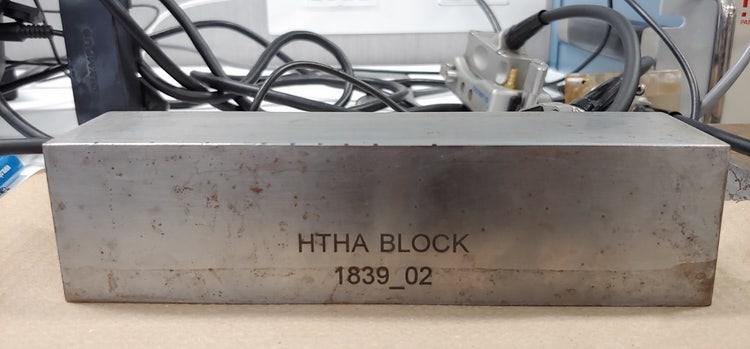
The second test configuration is a block with artificial HTHA with a 47mm thickness. Tests were conducted using a 10L64 A32 probe in contact mode.
Amplitude Data
To compare PAUT, FMC, and PWI amplitude data, these scan parameters were used: “full sparse” FMC and an angle step of 1° for PWI.
For this comparison, an isolated signal at 127 mm scanning distance was normalized to 100%.
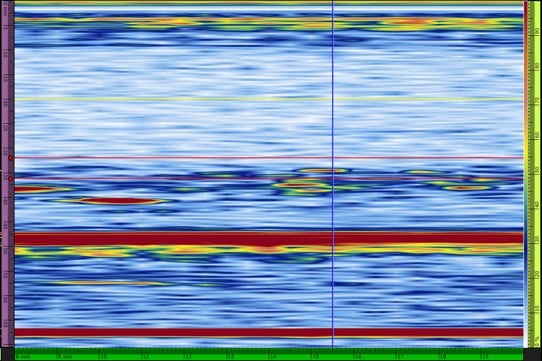
PAUT scan speed: 661mm/s
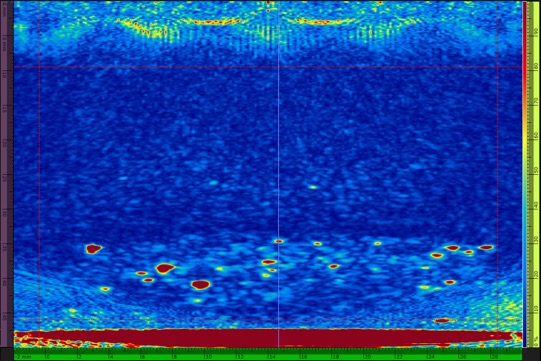
FMC/TFM max scan speed: 31mm/s
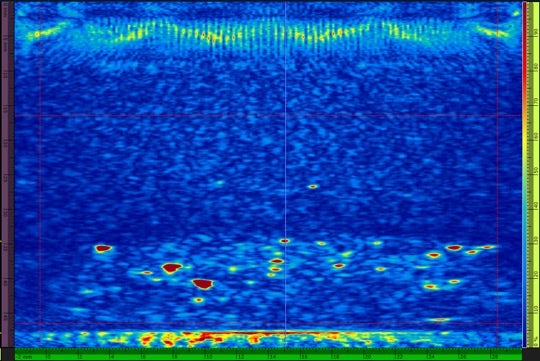
PWI/TFM max scan speed: 49mm/s
We see here that PAUT enables a much faster scan speed, but the signal is not even close to the information we can get with FMC and PWI. HTHA is an application where these technologies shine. PWI returns more information than FMC without generating the signals in the bottom corner and having a weaker back wall signal.
Phase Data
Using the default PCI color palette, PWI/PCI returns a weaker signal than FMC/PCI. When the color palette is adjusted (zoomed), however, PWI/PCI starts to show more details of the HTHA damage.
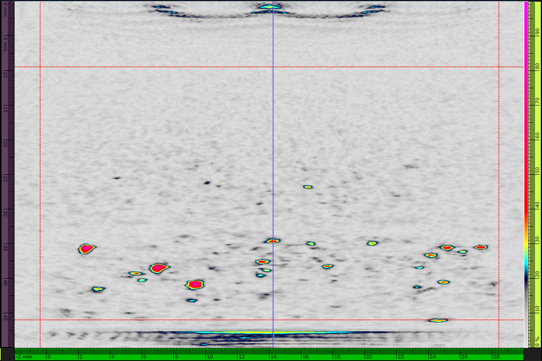
FMC/PCI max scan speed: 29mm/s
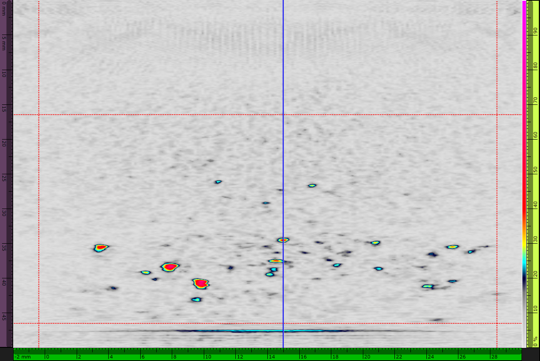
PWI/PCI max scan speed: 45mm/s
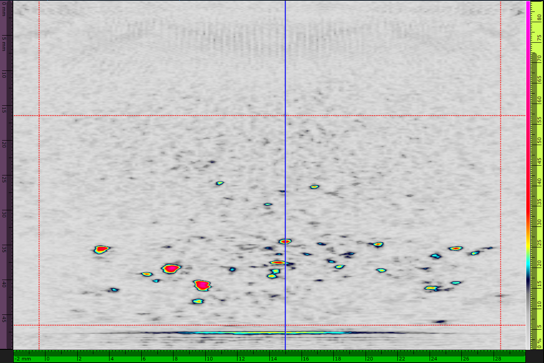
PWI/PCI max scan speed: 45mm/s (with color palette adjusted)
We see here that PWI also enables a better scanning speed.
Phase: Sparse
Because of the statistical nature of PCI, sparse firing is usually not recommended. However, it does not affect the signal for this configuration. The scanning speed using Sparse 1/2 firing is better than PWI with a 1° angle step.
PWI/PCI max scan speed: 45mm/s (with color palette adjusted)
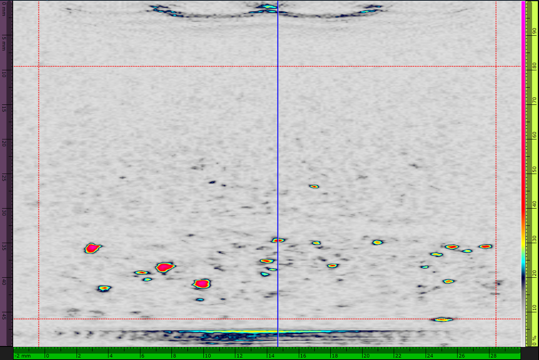
FMC/TFM Sparse 1/2 max scan speed: 57mm/s
Phase: Limited PWI Angles
The same signal degradation seen with TFM occurs with PCI.
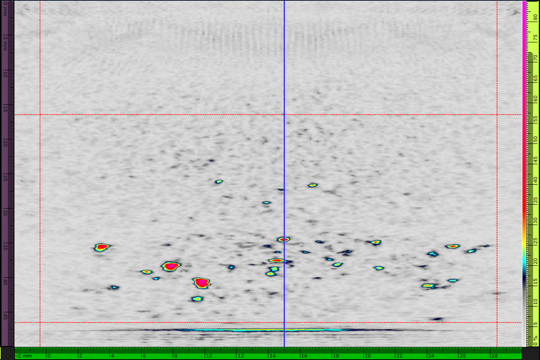
PWI/PCI 1° angle step max scan speed: 45mm/s
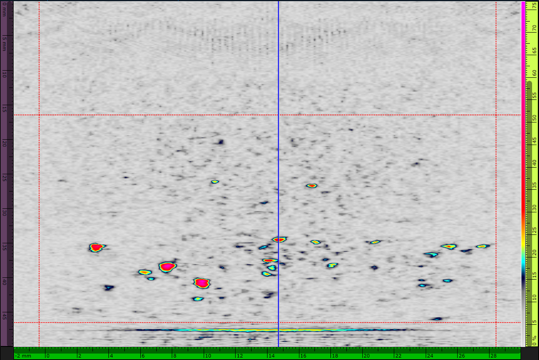
PWI/PCI 2° angle step max scan speed: 87mm/s
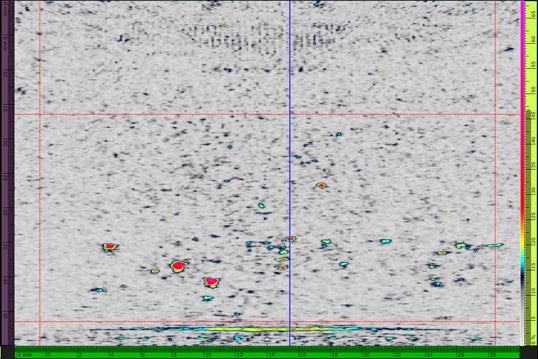
PWI/PCI 5° angle step max scan speed: 204 mm/s
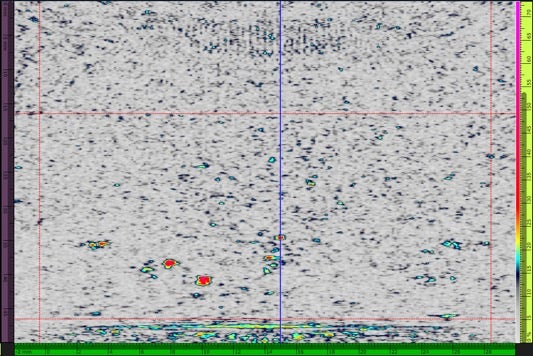
PWI/PCI 10° angle step max scan speed: 367mm/s
Conclusions
These imaging technique comparisons—weld inspection: PAUT vs. FMC vs. PWI and HTHA inspection PAUT vs. FMC vs. PWI—yielded the following conclusions:
25.4 mm V Weld Inspection
PAUT excelled—it provided results comparable to FMC-TFM and PWI-TFM but with a significantly higher inspection speed.
HTHA Inspection with a 10L64-A32 Probe in Contact
PWI outperforms PAUT and FMC, whether using TFM or PCI technology. Despite its slower scanning speed compared to PAUT, PWI increases the probability of detection.
Note: Maintaining a good signal-to-noise ratio (SNR) requires a small angle step or a high number of PWI beams.
Whether you’re using automated, semiautomated, or manual scanning methods, the OmniScan X4 flaw detector supports all of the aforementioned UT techniques. In some cases, you can combine multiple techniques in the same inspection to improve your detection probability and make it easier to identify and size your indications.
If you are interested in more details, reach out to your local Evident representative or contact us.
Featured Products

Stephan Couture
Global Advanced Product Support Specialist
Stephan worked with Evident at product development and as a Product Specialist for 9 years. In 2017, he transitioned to work in the inspection world to gather more applicative knowledge with the boots on the ground. In 2019, Stephan rejoined Evident as a leader for Global Advanced Product Application. Stephan is now supporting worldwide on applications, trainings, and industry projects as an Ultrasonic advanced products specialist.