Advances in Portable Phased Array for Aerospace Applications
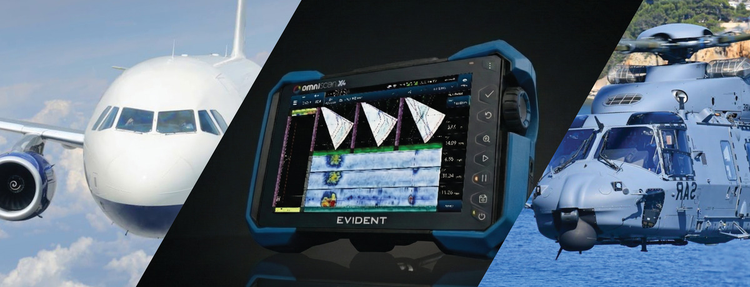

Nondestructive testing (NDT) plays a critical role in maintaining structural integrity, airworthiness, and long-term safety of aircraft. Critical components and assemblies are inspected continuously to verify proper function and compliance throughout an aircraft’s service life. As aircraft designs evolve—driven by increased use of composite materials, complex geometries, and advanced joining techniques—inspection technologies must evolve in parallel to address these emerging challenges.
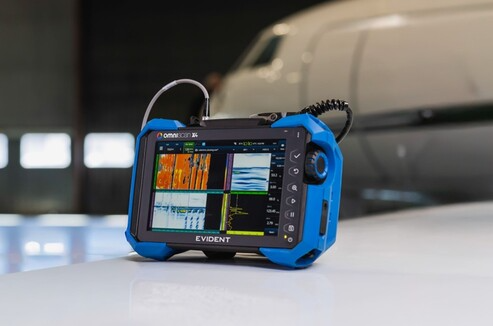
OmniScan X4 Multi-Technology Phased Array Flaw Detector for Aerospace NDT
The aerospace industry requires inspection solutions that are accurate, adaptable, and efficient, whether deployed on the manufacturing floor or during in-service maintenance. Evident’s recent webinar, “OmniScan™ X4: Advances in Portable Phased Array for Aerospace Applications,” examined how the OmniScan X4 phased array ultrasonic testing (PAUT) platform supports these requirements. The session highlighted the system’s multi-technology capabilities, advanced imaging techniques, and integrated software workflows, illustrating how the OmniScan X4 supports aerospace manufacturing, final assembly, and maintenance inspections.
The webinar was led by Florin Turcu, Senior Application Engineer, NDT, and Benoit Cabirol, NDT Product Application Leader. Their presentation combined a technical overview of the platform with practical usage examples, demonstrating how enhanced portability, imaging performance, and digital analysis contribute to more reliable, repeatable, and efficient aerospace inspections.
The Aerospace Inspection Landscape and NDT Challenges
Aerospace inspection spans the full lifecycle of an aircraft, from raw material verification and component manufacturing to final assembly and in-service maintenance. Inspectors are routinely required to detect corrosion, cracking, disbonding, delamination, thickness variations, and other discontinuities in materials such as aluminum or titanium alloys, carbon-fiber-reinforced polymers (CFRP), and hybrid structures.
To address this range of inspection scenarios, aerospace inspectors must be proficient in multiple ultrasonic methods and use equipment designed for consistent performance, versatility, and ease of operation. As emphasized by Florin and Benoit, other techniques, such as Eddy Current and Eddy Current Array, can be used to address more aerospace inspection challenges. However, the OmniScan X4 flaw detector is designed to support many applications using a wide range of phased array or ultrasonic probes, scanners, and techniques.
“In aerospace inspection, you’re dealing with a wide range of materials, defect types, and inspection stages, so relying on a single inspection method is rarely sufficient.”
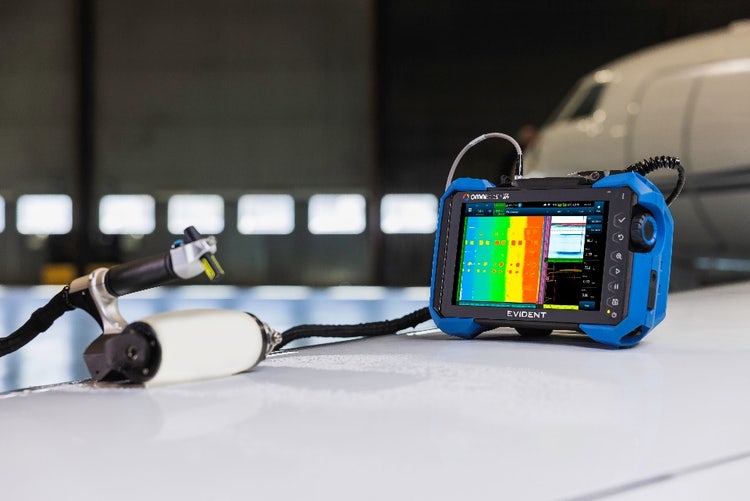
The OmniScan X4: A Portable Phased Array Platform for Aerospace
Evident’s OmniScan X4 portable phased array flaw detector was the central focus of the webinar. Designed for both manual and automated inspections, the platform integrates high-performance electronics, multi-channel capability, and advanced imaging modes in a rugged, field-ready form factor.
Florin and Benoit noted that the OmniScan X4 is not limited to a single application. Instead, it functions as a flexible inspection platform that can be adapted to manufacturing quality control, final assembly inspection, and preventive or corrective maintenance. This adaptability is particularly valuable in aerospace environments, where inspection requirements vary significantly across airframes, engines, and structural components.
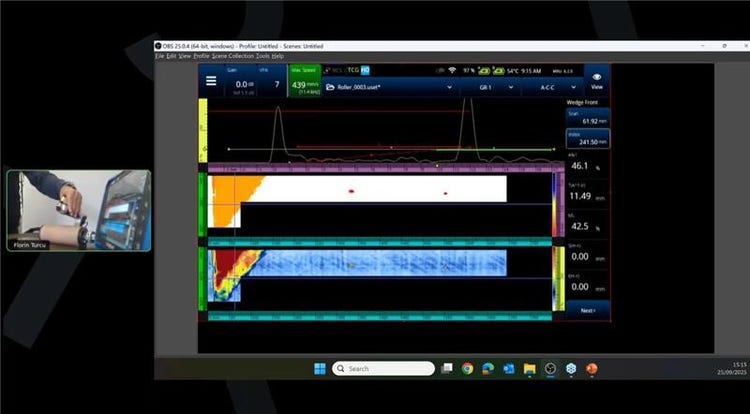
The webinar included a live demonstration of composite panel inspection using a local immersion technique that combined the RollerFORM™ scanner with the OmniScan X4.
Composite Panel Inspection of CFRP Using the RollerFORM and Local Immersion
Composite structures are increasingly prevalent in modern aircraft and present distinct inspection challenges. A key segment of the webinar focused on composite panel inspection, reflecting its growing importance as manufacturers continue to expand the use of composite materials.
During a live demonstration, Florin performed an inspection using the RollerFORM scanner in combination with the OmniScan X4, illustrating a local immersion technique. Unlike conventional immersion systems, this approach employs a closed water column integrated into the scanner wheel. This design provides consistent acoustic coupling while minimizing water usage, a practical advantage for both production environments and aircraft maintenance operations. The technique enables reliable detection of delaminations and disbonds, but also supports thickness measurement over a large area.
The demonstration highlighted several technical advantages of this approach, including improved near-surface resolution, support for large apertures using 64- or 128-element probes, operating frequencies typically ranging from 1 to 5 MHz, and efficient coverage of large composite surfaces.
“Local immersion using the X4 and RollerFORM is a practical, efficient alternative to full immersion setups, particularly in aerospace manufacturing and maintenance environments.”
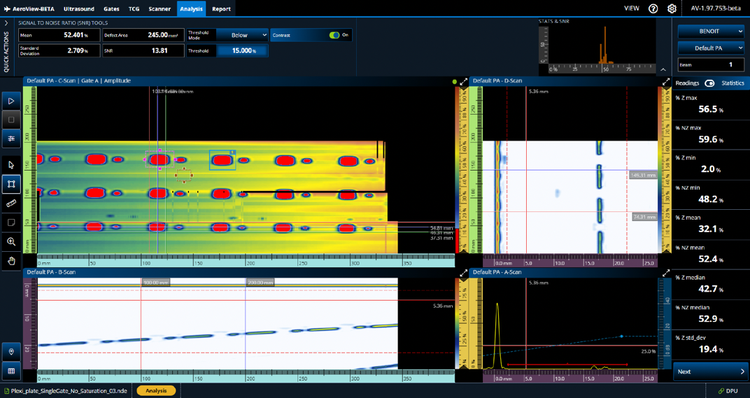
AeroView-Analysis highlights include a custom layout manager, custom palette editor, analysis gain, soft TCG, freehand sizing, sticky notes, and indication table.
From Data Collection to Insight: AeroView-Analysis Software
Acquiring high-quality inspection data is only one part of the aerospace inspection process. Effective analysis, interpretation, and reporting of that data are equally critical.
As part of the webinar, Benoit introduced AeroView™-Analysis, Evident’s software environment for ultrasonic (UT) phased array (PAUT) data analysis. Developed to support aerospace inspection workflows, AeroView-Analysis provides tools for detailed evaluation and standardized reporting. Key features include customizable layouts and color palettes, analysis gain and soft time-corrected gain (TCG), freehand sizing and annotation tools, indication tables with statistical summaries, signal-to-noise ratio (SNR) analysis tools, and automated report generation. In addition, the software allows all views to be displayed at a 1:1 ratio, helping inspectors maintain spatial accuracy when evaluating flaw size and location.
AeroView-Inspection in Practice
Benoit demonstrated AeroView-Inspection, Evident’s PC software, connected to an OmniScan X4 to acquire repetitive or large data.
The demonstration included inspections performed with near-wall probes mounted on a Glider XY scanner. This configuration is optimized for near-surface resolution and is well suited for inspecting thin skins, bonded structures, and subsurface flaws. It is also designed to minimize near-surface dead” zones and support both manual and automated inspection setups.
“Together, AeroView-Inspection, near-wall probes, and specialized wedges allow aerospace inspectors to detect small defects that might otherwise be obscured by near-surface dead zones.”
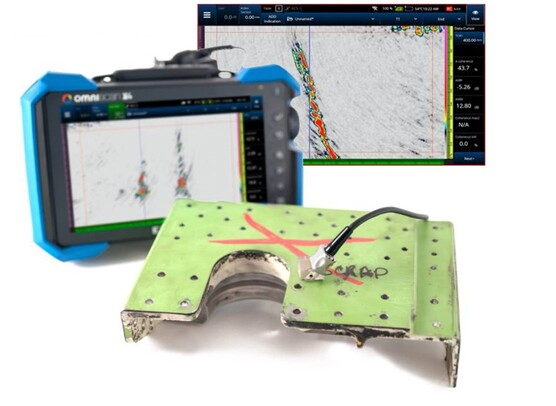
The webinar included a live demo of crack detection and evaluation in an aluminum part using PCI (Phase Coherence Imaging), which enhances crack tips and branches on the resulted image.
Advanced Imaging for Aerospace: TFM and Phase Coherence Imaging
The final technical segment of the webinar focused on advanced imaging techniques, with particular emphasis on Phase Coherence Imaging (PCI). Unlike traditional amplitude-based imaging methods, PCI leverages phase information to enhance the visibility of crack tips and branching. This capability is especially useful for evaluating fatigue cracking in aluminum structures, a common concern in aging aircraft fleets.
Benoit and Florin demonstrated that PCI is integrated into the OmniScan X4. Moreover, the Application Preset feature embedded in the device allow inspectors to be confident with this new imaging technique. The improved contrast and clarity provided by PCI can support more accurate flaw characterization and maintenance decision-making.
A Unified Approach to Aerospace NDT Workflows
A key takeaway from the OmniScan X4 webinar was the importance of an integrated NDT ecosystem. Evident’s hardware, probes, scanners, and software are designed to operate as a unified workflow, from data acquisition with the OmniScan X4 to analysis and reporting using AeroView software.
From advanced composite inspection techniques to integrated analysis workflows, the OmniScan X4 ecosystem represents a shift toward more connected and consistent aerospace inspection processes. For aerospace organizations, this approach enables greater inspection repeatability, improved defect detection and characterization, streamlined training and deployment, and improved traceability and documentation.
“The real value in aerospace NDT comes from versatility—one system that can support multiple PAUT methods and workflows to inspect different materials as inspection needs evolve.”

OmniScan X4: Advances in Portable Phased Array for Aerospace Applications Webinar with Evident experts Florin Turcu and Benoit Cabirol
Watch this on-demand webinar for an in-depth look at how recent advances in portable phased array technology are influencing aerospace inspection and see how the OmniScan X4 supports inspection of increasingly complex aerospace structures.
Schedule a Free OmniScan X4 Demo
Explore the capabilities of the OmniScan X4 firsthand. Schedule a personalized demo to see how the platform can support current aerospace inspection requirements while remaining adaptable to future challenges.