How the OmniScan™ X4 128:128PR Helps Tackle Complex Inspections: Insights from Paul Hayes
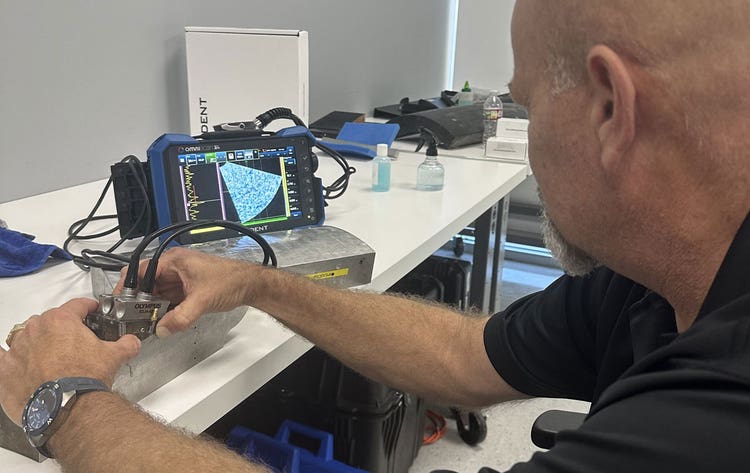
Evaluating an arrays SNR on a noisy vintage cast austenitic stainless steel cal block

Paul Hayes, Owner at Sinewave Solutions, has more than 25 years of experience supporting nondestructive testing across nuclear, power generation, aerospace, and other safety-critical industries. Drawing on his extensive field background and work with advanced ultrasonic techniques, Paul shares his perspective on how phased array technology and high-channel instruments such as the OmniScan™ X4 128:128PR* flaw detector has reshaped the way complex inspections are performed.
*Patent Pending
Q: Paul, can you share how ultrasonic inspection technology has evolved over your career and what impact those changes have had on the industries you serve?
A: I’ve been working around nuclear power plants and other critical industries since the mid-1990s. My first nuclear job was at Nine Mile Point back in 1996, when everything we did was on conventional A-scan equipment. Looking back now, it’s amazing how much we were able to do with such limited tools, and how many things we simply couldn’t see.
The evolution from A-scan to phased array, and now to powerful 128:128 platforms like the OmniScan™ X4 128:128PR, has completely changed how we approach the most challenging inspections in nuclear, power generation, aerospace, and even additive manufacturing.
Today, I wouldn’t want to tackle those same applications without that kind of imaging power.
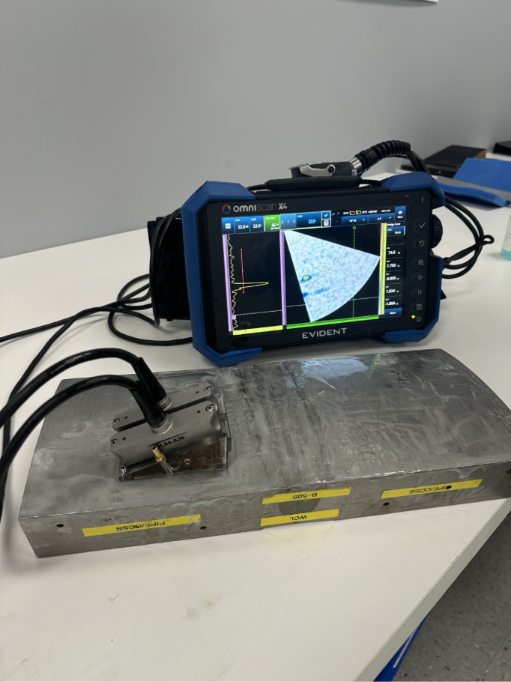
The OmniScan X4 128:128PR in action
From “Art Form” to Imaging: Solving IGSCC with Phased Array
One of the first big challenges in my career was IGSCC (intergranular stress corrosion cracking). These flaws are notoriously difficult to detect, especially with old A-scan units.
On A-scan, an IGSCC indication is a sharp, narrow signal that can look almost identical to geometry. The cracks typically sit right at or near the weld root in 304/316 stainless, where you already have loud signals from the root itself. So, you’d have a big root response, and the only clue there might be a crack was a tiny shift in that signal. Maybe the echo moved slightly, maybe the shape changed just a bit.
We missed a lot. Everyone did.
When we first moved into phased array, we saw a significant improvement in detection. Instead of staring at a single A-scan trace and trying to interpret a small blip, we could actually see the weld volume in an image. That slight shift in the root that you might completely overlook on an A-scan, suddenly showed up visually as “something where it shouldn’t be.”
The other big factor was dynamic range. Early phased array systems still had limits, typically at 100% or 200% amplitude ranges that would saturate on loud roots. You couldn’t pull the signal down enough to see what was going on. With today’s 16-bit systems and extended amplitude ranges up to 800%, like you have on modern OmniScan platforms, you can finally control those big signals:
- Pull the loud geometry down on screen
- Avoid saturation
- Open up the view around the root to see the actual flaw
For IGSCC, that combination of high dynamic range and actual imaging turned one of the hardest inspections in nuclear into something repeatable, defensible, and much less dependent on “art” and instinct.
Dissimilar Metal Welds and Overlays: Where 128:128 Really Shines
If you ask me what the hardest inspections have been over my whole career, dissimilar metal welds (DMWs) and weld overlays are right at the top of the list.
In a typical dissimilar metal weld in nuclear, you might have:
- Stainless pipe
- Inconel 182 buttering
- Inconel weld metal
- More buttering
- Then carbon steel
Each interface can bend the beam, scatter it, or produce reflections that look exactly like cracks. In the early days, we used automated A-scan systems on some of these welds. The data looked pixelated and noisy. We’d know “something” was there, but unless it was obvious it was nearly impossible to have confidence in what we were seeing.
I remember one case where, during an outage, the data looked iffy, and we left thinking maybe there was something, maybe there wasn’t. By the next outage, that weld was leaking on the floor. We realized that what we thought might be nothing was, in fact, a crack.
That kind of experience is humbling.
This is where modern phased array makes a huge difference:
- You can focus larger, lower-frequency probes to punch through multiple interfaces and the noisy Inconel.
- Being able to focus the sound more efficiently at depth, improving sensitivity at the crack tip, even when it’s buried under an overlay and multiple layers of weld and buttering.
- You can run multiple groups simultaneously at different focal depths, different angles, even different skew angles, without rescanning.
On weld overlays, things get even more interesting. The fix for leaking DMWs in many plants was simply to overlay them: put a thick Inconel weld layer over the original weld and pipe. It works structurally, but from an ultrasonic perspective you’ve just made the problem harder. Now the crack tip might be 1.5 inches or more deep, through highly attenuative material, with complex interfaces.
Again, this is where the extra channels and large apertures of a system like the OmniScan X4 128:128PR really matter:
- You can drive big apertures at low frequencies with enough energy to punch through overlays and still see the crack tip.
- You can set up skewed and focused groups to catch cracks that are off-axis or lying in odd orientations.
- You can do automated overlays inspections using phased array instead of manual methods, which more and more plants are moving toward.
A lot of nuclear plants now won’t even consider manual inspection for overlays. It’s automated, and it’s phased array, because the imaging and coverage are just that much better.
Skew Angles: Separating Geometry from Cracking in Real Time
One of the more underrated capabilities that really becomes powerful on a with more pulsers, such as the 128:128PR, is skew angles.
In weld inspection, we fight a lot of geometry that can mimic a crack. To tell the difference, and discriminate between what is real or not, we have a set of rules almost like a flowchart; first can you see it from both sides of the weld, then does it plot to a suspect location, does it exhibit through-wall depth and “walk”, can you see it with different angles, will it hold a skew? Having a set skew angle, from a matrix array, at +/- a fixed degree becomes an important confirmation tool. More elements in the passive direction enables a greater steering range. More elements also require more channels. These skewing capabilities on the passive axis can help with:
- Noisy roots
- Counterbores (internal machining steps at the ID)
- Mismatches between pipes
- Backing rings / backing plates
From looking straight out the front of the probe only perspective, all these features can produce strong, clean reflectors right where you’re looking for cracks, especially at the ID. Many pipes have been cut out over the years because a noisy root or counterbore “looked” like a crack with conventional approaches.
Skew angles change the game.
With skewing, you’re not just steering the beam in the primary direction; you’re also steering sideways. On a phased array unit with high pulser count, you can:
- Build probes that are wider in the passive direction (more elements side-to-side)
- Maintain forward looking coverage and skew coverage at the same time
- Run at zero (looking forward) plus positive and negative skews as separate groups in a single scan
Here’s why that matters:
- Geometry (counterbores, mismatches, backing rings) are very orientation-dependent. When you scan with a skew angle, the beam tends to glance off these surfaces and not return a strong signal.
- Cracks, on the other hand, have facets in many directions. When you skew, one of those angles will “catch” the facet and give you a strong, characteristic response. A real crack will definitely hold a skew
So, if you have a suspect signal looking forward, but nothing at your skew angles, it’s likely geometry.
If you see a response at looking forward and strong, consistent responses in one or more skew angles, you’re now looking at something that behaves like a crack.
What the 128:128 gives you is the channel count to run those skew groups without compromise. You don’t have to swap setups, reload configurations, or rescan the weld. You can do live, real-time comparison between:
- Different angles
- Different focal depths
- Different frequencies
- Different skew directions.
All on a single pass.
Thermal Fatigue and Off-Axis Cracks: Coverage You Can Trust
Another tough problem is thermal fatigue. Those cracks can occur at odd orientations because they’re driven by a combination of thermal cycling and mechanical loading. They’re still typically surface connected at the ID, but they don’t always lie parallel or perpendicular to the pipe. They can run off-axis in strange directions.
With conventional scanning using a typical X-Y scanner, and a single beam direction, it’s easy to go right over the top of a thermal fatigue crack and never see it. If you happen to hit it just right, you get a response. If not, you miss it.
When you bring in skewing and multiple focal depths on a system like the OmniScan X4 128:128PR, you can:
- Cover off-axis orientations much more effectively
- Use skew angles to “sweep through” the volume and catch cracks that don’t align with your main beam
- Fine-tune your focal depths to make sure you’re not over- or under-focusing for a given wall thickness
It’s not just more data; it’s more confident data. After you’ve worked with skew groups and multiple focal depths for a while, you start to trust that if something is there, one of those angles will pick it up.
Aerospace, Additive Manufacturing, and Noisy Materials
Outside of nuclear, I’ve now worked with aerospace composites on complex cores, honeycomb, and additive manufacturing. The common theme? Noisy, attenuative, and unusual materials.
Some of these materials have foam or honeycomb core. At first glance, you’d think ultrasound has no business traveling through that material. But with the right probe design and enough energy, you can get useful data through it.
This is another place where having 128 channels to work with pays off:
- You can design wider probes and still fully drive them.
- You can choose lower frequencies for penetration without completely sacrificing resolution.
- You can cover more surface area per pass, which is crucial in aerospace where components like wing structures are long and scanning distances are huge.
I’ve seen situations where a wing spar or radius section used to take multiple shifts to scan with small step sizes and conventional setups. By moving to a wide array driven by a powerful phased array unit, we can cut scan times down from:
- Four shifts of scanning
- To “done before lunch” of pure scan time
That’s not just a technical improvement; that’s a throughput revolution for production.
Some of these materials are still too challenging and require significantly more energy. That’s why I designed the T-800 that is compatible with the OmniScan. But that’s another topic for another time!
Outage Time, Speed, and Real Business Impact
In nuclear, time in an outage is money, big money. Early in my career, an average shutdown with typical UT exams might keep us on site for about a month. As phased array became standard, those same workscopes started taking 10 days to 2 weeks instead.
A big part of that is speed:
- Phased array can cover the weld volume much faster than a conventional A-scan.
- Automated phased array reduces the need for manual rescans and reinterpretation.
I’ve seen single weld sections that used to take 30–40 minutes now scan in about 60 seconds. At first, technicians were worried that this kind of speed would put them out of a job. The reality is, there’s still no shortage of work, but now the plants get their outages over and get back online sooner, with higher quality data and fewer surprises.
Why More Pulsers Matters
At the end of the day, one principle has held true throughout my entire career:
The right probe solves the application, but you need the right instrument to power that probe.
An instrument like the OmniScan X4 128:128PR gives you:
- The power and channels to drive the probes you actually need for the hardest materials: stainless, Inconel, overlays, cast, additive.
- The flexibility to run multiple focal depths, angles, frequencies, and skew groups simultaneously for live comparison.
- The coverage and speed to turn multi-shift scans into minutes and to help plants shorten outages without sacrificing safety.
- More channel availability is also a multiplier for probe capability.
If I could go back and revisit the hardest inspections of my career (IGSCC in old stainless piping, dissimilar metal welds that later leaked, overlays with buried cracks, noisy cores in aerospace, and attenuative additive parts), I would definitely want to bring the latest phased array tools and an OmniScan X4 128:128PR with me every single time.
Modern phased array didn’t just make inspections easier.
It made them more reliable, faster, and in many cases, truly possible for the first time.
— Paul Hayes, Owner at Sinewave Solutions