Secure and Faster File Transfer in the Field with MXU 6.4

In industrial inspection environments, data integrity and reliability are essential. Inspection teams often operate in locations where internet connectivity is limited, inconsistent, or unavailable. In these situations, secure and efficient file transfer is critical to maintaining productivity and ensuring confidence in inspection results.
The OmniScan X4 already features an embedded OneDrive solution for exchanging data over an internet connection (via Wi-Fi or Ethernet). This free service enables users to manually synchronize data between the device and Microsoft OneDrive cloud storage.
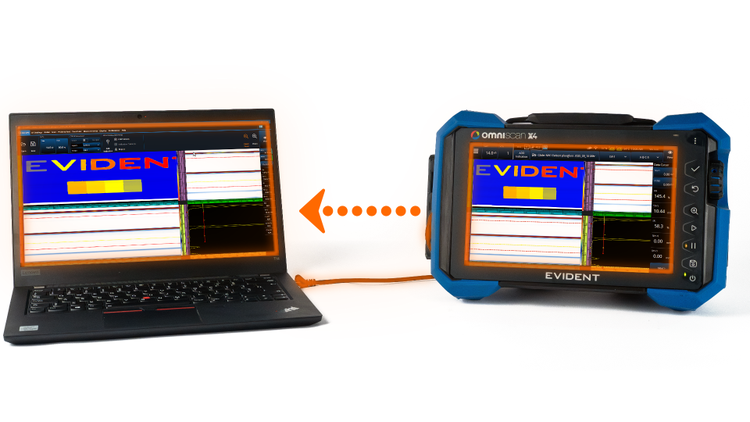
The MXU 6.4 software upgrade introduces SFTP (Secure File Transfer Protocol) file transfer support for the OmniScan™ X4 flaw detector, enabling secure and direct data download between the instrument and a computer over a local network. Connections can be established using either an Ethernet cable or local Wi-Fi, without relying on internet access.
A Secure Platform Built on Trust
The OmniScan™ X4 flaw detector is widely recognized as a secure and dependable inspection platform. Inspectors rely on it to collect accurate data, and customers trust the integrity of the results it produces. Data security is not an afterthought, it is fundamental to maintaining credibility, meeting compliance requirements, and protecting sensitive inspection information. By adding SFTP capability, MXU 6.4 strengthens the secure ecosystem surrounding the OmniScan™ X4 flaw detector.
With MXU 6.4:
- The password is defined and managed by the user, providing full control over access credentials
- There is no risk of losing a default or externally managed password
- Encrypted communication protects data during transfer over the local network
In inspection workflows, trust is essential. Secure data handling helps reinforce confidence between inspectors, asset owners, and stakeholders.
Faster, Direct Data Transfer over a Local Network
With MXU 6.4, inspection data can be transferred using SFTP over a dedicated local connection. This approach provides more predictable performance compared to workflows that depend on external internet access or unstable wireless networks.
Once SFTP is configured, file transfers over a local network are significantly faster than using a USB flash drive or SD card. This eliminates the need to manually export, physically transport, and reimport files.
Unlike USB transfers, which may freeze or fail when a large number of files is selected, SFTP does not impose practical limits on the volume of files transferred. Large datasets can be moved reliably and efficiently.
All file types can be transferred, including:
- Setup files
- Inspection data
- Images
- Reports
- And other associated files
This ensures complete data retrieval without additional handling steps.
Parallel Operation for Greater Productivity
File transfer via SFTP operates in parallel with other instrument activities. The OmniScan™ X4 flaw detector can continue performing other tasks while files are being transferred.
This parallel transfer capability helps maintain workflow continuity and reduces idle time during inspections.
In many PAUT inspection scenarios—such as offshore projects where analysts are located in a remote cabin, water tank inspections in which the analyst works from an office while the operator remains in the workshop, or onshore pipeline projects where the analyst stays in a vehicle while operators work outside—the operator and analyst are physically separated. As a result, reliable remote data transfer is essential.
Automated and Scheduled Transfers
PC Software also enables automation features that further streamline data management:
- Automatic transfer can be initiated from the PC to retrieve newly saved data from the instrument
- Real-time synchronization of remote folders ensures newly created files are automatically copied
- File transfers can be automated and scheduled
For example, data can be configured to transfer overnight or during scheduled breaks. This allows inspection teams to start the next shift with files already available on their computer or network location.
While wireless transfer methods remain available, performance may vary when internet connectivity is required or when network conditions are inconsistent. By contrast, SFTP over a controlled local connection helps ensure stable, repeatable, and high-speed data transfer in the field with the following features:
- Resume capability enables large files to continue transferring from the point of interruption, eliminating the need to restart the entire transfer after a network interruption.
- Checksums verify that each received file matches the original, ensuring data integrity for critical PAUT inspections.
Reduce Delays in Challenging Conditions
SFTP support in MXU 6.4 helps minimize workflow interruptions in situations such as:
- Limited or inconsistent wireless coverage
- The need for faster handoff of inspection files
- On-site workflows that require reliable and predictable transfer performance
- Restricted or unavailable internet access
- By removing dependence on external networks, and eliminating the need for physical USB or SD media, teams can transfer files directly and efficiently, reducing downtime while maintaining secure data management practices.
Designed for Real-World Inspection Environments
Field inspections frequently take place in industrial facilities, remote locations, or secure sites where internet access may be restricted. In these environments, predictable performance and secure data handling are critical.
By removing dependence on external networks—and eliminating the limitations of removable media. SFTP file transfer in MXU 6.4 provides:
- Secure, user-controlled access
- Faster transfer speeds compared to USB or SD media
- Parallel operation without interrupting inspections
- Automated and scheduled data synchronization
- No practical limits on file quantity
For inspection teams using the OmniScan X4 flaw detector, this enhancement supports operational efficiency while reinforcing data security and customer trust.