How Portable XRF Can Support Compliance with EU PPWR Heavy Metal Requirements


The EU Packaging and Packaging Waste Regulation (PPWR), Regulation (EU) 2025/401, introduces requirements for substances in packaging, including a limit on the combined concentration of lead (Pb), cadmium (Cd), mercury (Hg), and hexavalent chromium (Cr[VI]). Article 5 sets a maximum combined concentration of 100 mg/kg (100 ppm) for these four restricted heavy metals in packaging and packaging components.
Manufacturers need a practical way to assess incoming materials, packaging components, and finished products quickly without waiting days for laboratory results. This creates demand for rapid screening technologies that can identify potential noncompliance before products enter the supply chain.
For packaging manufacturers and suppliers, this raises important questions when it comes to the best ways to implement rapid screening to support PPWR compliance:
Can portable XRF be used as a rapid screening tool for PPWR compliance programs?
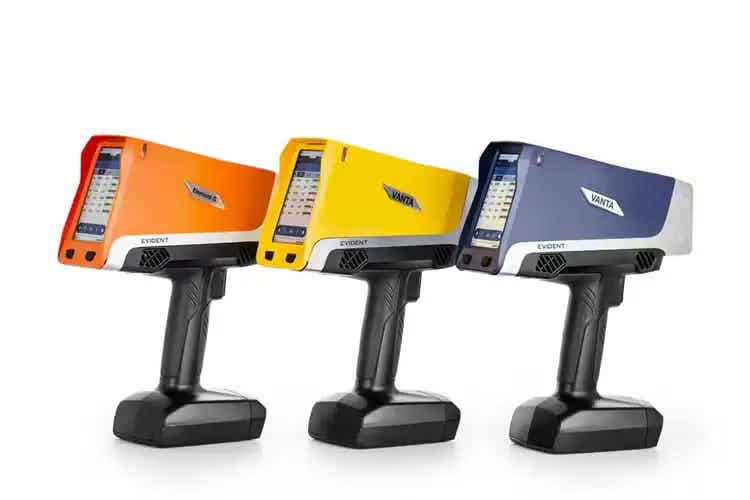
Yes, portable X-ray fluorescence (XRF) analyzers, such as the Vanta™ Element-S or Core, can measure the concentrations of the following elements within seconds, directly on the production floor, warehouse, or supplier facility:
- Lead (Pb)
- Cadmium (Cd)
- Mercury (Hg)
- Total chromium (Cr)
XRF is a nondestructive technique requiring little or no sample preparation, enabling high-throughput screening of packaging materials including plastics, coatings, inks, paper products, laminates, and metal packaging components. Rather than sending every sample to an external laboratory, companies can use XRF to quickly identify materials that may require further investigation.
As XRF can only measure total chromium, what about the exact PPWR requirement for hexavalent chromium (Cr[VI])?
PPWR specifically restricts Cr(VI); XRF can only measure total chromium elementally. Thus XRF can only identify if chromium is present and not whether it is in a specific chromium oxidation state.
This is similar to established RoHS screening practices, where portable XRF is routinely used to measure total chromium as a conservative screening approach. If the combined concentration of Pb, Cd, Hg, and total Cr is well below 100 ppm, manufacturers can have greater confidence that the total contribution from regulated heavy metals is unlikely to exceed the PPWR threshold.
Where elevated chromium concentrations are detected, additional laboratory testing may need to be performed to determine the chromium species (if required under a company's compliance program).
As XRF cannot distinguish between chromium oxidation states, any compliance decision regarding Cr(VI) should be based on a company’s established compliance procedures and, where appropriate, confirmatory laboratory testing.
How do Vanta XRF analyzers simplify PPWR screening?
Vanta XRF software includes a feature known as Pseudo Elements, which allows users to create custom calculations based on measured elemental concentrations. By creating a dedicated PPWR pseudo element calculation that automatically sums Pb + Cd + Hg + Cr, the analyzer can display a single result that can be compared directly against the 100 ppm PPWR limit.
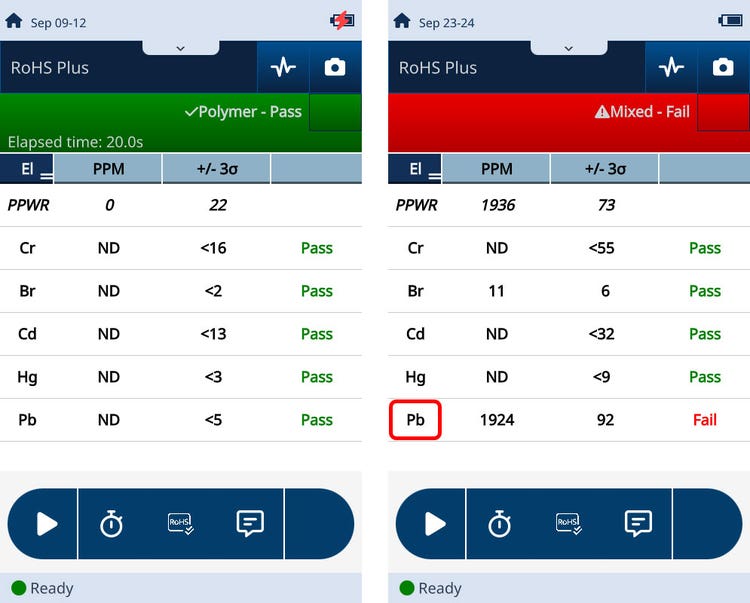
Vanta XRF analyzers feature easy-to-use software that lets inspectors instantly see elemental composition data.
Additional Vanta XRF software functionality includes:
- Green/pass indication when the combined value is below 100 ppm
- Red/fail indication when the combined value exceeds 100 ppm
- User-configurable action levels
- Automatic reporting of the PPWR screening result alongside individual element concentrations
These capabilities help operators make informed screening decisions directly in the warehouse or workshop without additional calculations, while also supporting broader compliance programs.
What are the benefits of using Vanta XRF for PPWR screening?
For packaging manufacturers, converters, brand owners, and recyclers, portable XRF offers several advantages:
- Rapid screening results in seconds
- Onsite analysis without transporting samples to a lab
- Nondestructive testing with little or no sample preparation
- Simultaneous measurement of Pb, Cd, Hg, and total Cr, as individual elements or as a sum
- Early identification of materials that may require further investigation
- Reduced external lab costs
- Improved supplier qualification and incoming goods inspection
- Greater process efficiency through real-time screening decisions
While PPWR screening may be the immediate driver, Vanta XRF analyzers can also support a wide range of routine QA/QC activities. From verifying alloy compositions and confirming incoming material identity to helping prevent material mix-ups on the production floor, Vanta XRF delivers value throughout the manufacturing and supply chain process.
As PPWR requirements become a growing focus for the packaging industry, portable XRF can serve as an effective first-line screening tool supporting packaging compliance, helping companies rapidly assess heavy metal content, identify potential risks, and prioritize samples that may require laboratory confirmation testing.

The Vanta XRF Advantage: Meeting PPWR Requirements with Confidence
As the packaging industry prepares for implementation of PPWR, organizations need efficient methods for monitoring heavy metal content throughout their supply chains. Vanta portable XRF analyzers enable rapid onsite screening of lead, cadmium, mercury, and total chromium, helping manufacturers identify potential concerns before materials are accepted, processed, or shipped. Combined with configurable PPWR screening calculations and workflow automation, Vanta XRF can help streamline compliance screening activities while reducing dependence on time-consuming laboratory testing.
1Learn how Vanta XRF can support your PPWR compliance program