RBIS: 회전 바 검사 시스템

RBIS는 위상 배열과 와전류 배열 기술을 함께 활용하여 빌렛(billet)이라고 하는 둥근 대형 바의 전체 볼륨과 표면을 검사합니다. 빌렛이 회전하고 검사 헤드를 지지하는 캐리지가 선형으로 이동하는 동안 검사가 이루어집니다.
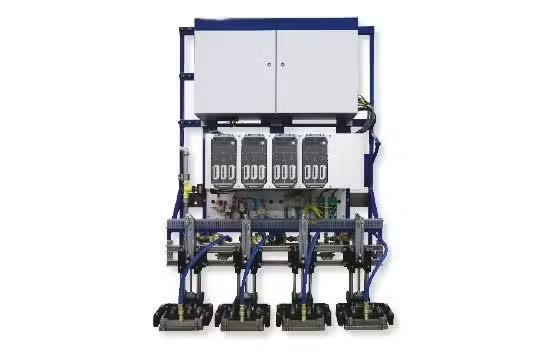
Rotating Billet Inspection System (RBIS)

Overview

The rotating billet inspection system (RBIS) is a turnkey solution that uses phased array (PA) and eddy current array (ECA) technology integrated into a fully automated testing system to meet stringent requirements for volume and surface inspections. Key benefits include:

  • Both volume and surface inspection in a single system
  • High throughput that saves you time compared to conventional approaches
  • Minimize your dependency on operator skill with automatic calibration
  • Get the most out of the system with 2D mapping
  • Flexibility to inspect round billets made from carbon steel, stainless steel, aluminum, and titanium as well as black and bright bars
  • Fast changeover limits your downtime

Designed to be an easy-to-use solution that provides repeatable results, the system includes:

  • Dedicated project management
  • Instruments, probes, and mechanical equipment
  • Software
  • Commissioning, training, and after-sales support
RBIS

Complete Billet Inspection

Full Body Inspection with Phased Array

While the billet is rotated, the inspection head travels on a gantry along its length. Air cylinders move the wedges down at the beginning of the inspection sequence and up at the end.

The probes are mounted in Evident water wedges that have many degrees of freedom and pneumatic suspension, helping ensure optimal coupling.

Specific wedges are used for longitudinal and shear waves to inspect both the billet’s volume and subsurface.

Surface Inspection with Eddy Current Array

Surface-breaking defects are inspected using eddy current array. A special probe holder is used to enable in-contact inspection with optimized lift-off for any billet diameter. The probes feature a ceramic face, making them resistant to damage.

High-Quality Results

The system meets the productivity requirements of the metal manufacturing industry while adhering to the highest international quality standards.

Water Wedge

The water wedge’s degrees of freedom and pneumatic suspension enable it to follow the pipe’s movement. The wedge uses an Aqualene membrane that maintains a thin film of water for excellent coupling. The water path inside the wedge remains undisturbed for high repeatability on small reference defects. Wear plates are available to fit the diameter of your billet.

RBIS

Advanced Inspection Head

The electronics are embedded in the inspection head to shorten the cable length and reduce electromagnetic noise. The modular design makes it easy to upgrade or conduct maintenance. A single head can hold up to 8 wedges and 5 QuickScan LT and 1 QuickScan ECA acquisition units while accommodating standard options, such as onboard paint marking and a prewet device.

Phased Array Probes

PA probes provide a tight overlap between groups of elements that are electronically adjustable depending on the size of the defects, resulting in a high energy density in the billet and repeatable performance.

Automatic Calibration

To achieve a thorough inspection, each probe must be calibrated. During calibration, the apertures of each probe pass over a known defect, and the probe’s gain level is automatically adjusted. This feature enables users to easily perform and validate a precise calibration of each focal law, saving time without relying on the user’s skill.

  • All probes can be calibrated in a single automatic sequence
  • Calibration check performed under normal production conditions
  • Each reference defect is validated to help ensure they’re detected above the alarm level
  • Results are displayed in an easy-to-interpret strip chart
RBIS

Software and Acquisition Units

Phased array (PA) and eddy current array (ECA) technology, a powerful acquisition unit, and advanced software deliver a powerful inspection system.

PA and ECA Acquisition Units

The QuickScan PA 32:256 module meets IP55 standards, while the QuickScan EC unit provides the flexibility to inspect the billet’s surface. Both units easily integrate into industrial environments.

PA and ECA Acquisition Units

Easy Setup

QuickView software makes it easy to set up the system and acquire and manage data. The software’s wizard makes it simple to create setups for each part size. The inspection configuration and calibration parameters for each billet diameter are saved and easily retrievable. The final results are merged and displayed to clearly differentiate between accepted and rejected billets.

  • Quickly access predefined inspection setups
  • Software wizard makes it simple to create new setups
  • Restrict access to certain users to help minimize operator errors
  • Calibration and inspection information are stored for traceability
PA and ECA Acquisition Units

Mapping

Using a reference signal at each revolution, the system provides the XY defect position and measures the size of the defect’s surface and its orientation. Data mapping enables the system to perform the 2D marking used by prove-up or automatic grinding applications.
PA and ECA Acquisition Units

Resources

Application Notes

Solutions

Product Resources