OmniScan X3 Phased Array Flaw Detector
Every flaw detector in the OmniScan™ X3 series is a complete phased array toolbox. Innovative TFM and advanced PA capabilities help you identify flaws with confidence while powerful software tools and simple workflows improve your productivity.
-
Product Availability:
The OmniScan X4 has replaced this discontinued product.
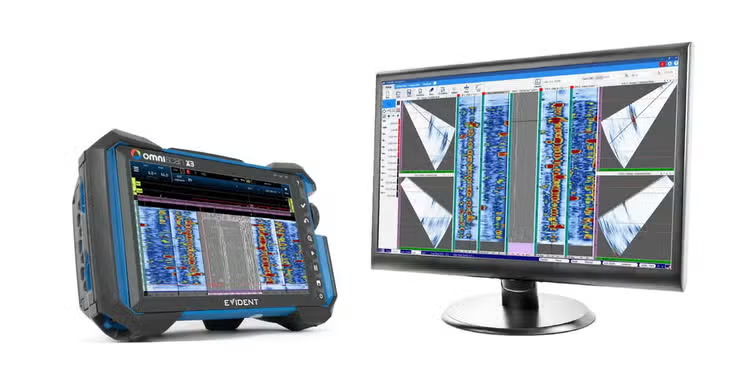
OmniScan X3 and OmniScan X3 64 Thickness and Flaw Inspection Solutions
Overview
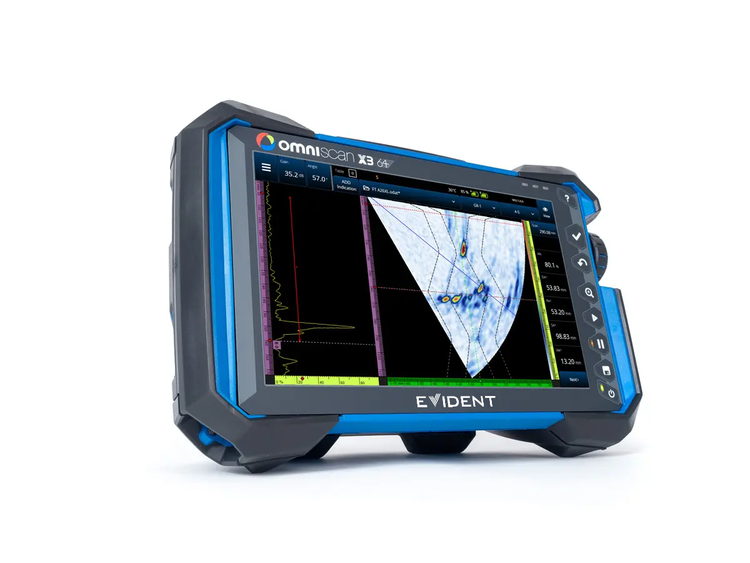
OmniScan™ X3 64 Phased Array and TFM Flaw Detector with Advanced Capabilities
Power You Can Carry
Housed in the field-proven rugged and portable OmniScan X3 enclosure, the OmniScan X3 64 flaw detector’s powerful focusing capabilities supported by its larger element-aperture capacity enable you to fully exploit 64-element phased array probes and 128-element aperture TFM. Utilize its enhanced performance to meet the inspection challenges of thick and attenuative materials and expand your potential to develop new procedures for a wider range of applications.
How Our Customers Use the OmniScan
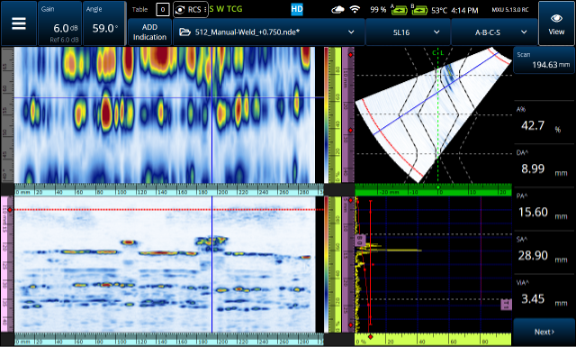
Save Time and Energy Screening Welds with the Merged B-Scan
If you’ve ever wondered whether there’s a more efficient way to perform weld screening than simply scrolling through B-scans, you’ll want to hear about our solution. With the MXU 5.13 software update, we introduced an innovative B-scan view for the OmniScan™ X3 series that has the potential to revolutionize this time- and attention-consuming technique. Used as a validation tool, it can give you more confidence in your assessments and help ease the whole B-scan screening process.
5 Main Advantages of Phase Coherence Imaging (PCI)
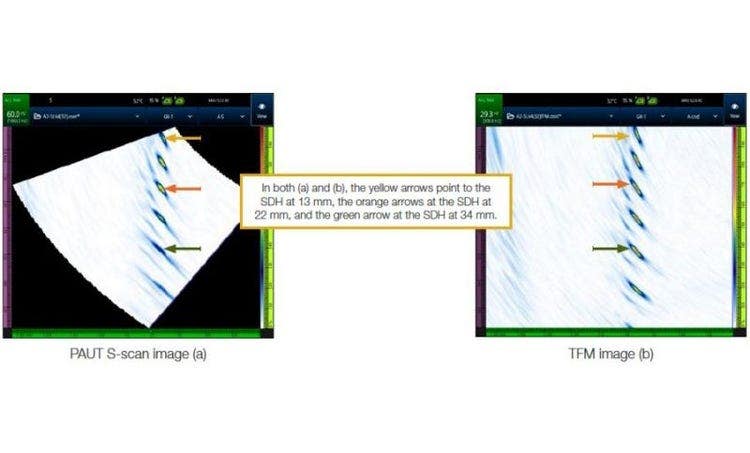
With the release of MXU 5.10 software, the OmniScan™ X3 64 flaw detector gains a new advanced ultrasonic inspection technique: phase coherence imaging (PCI). As soon as your OmniScan X3 64 unit is updated, you can start taking advantage of PCI to achieve live total focusing method (TFM) images with unprecedented clarity and sensitivity to small defects.
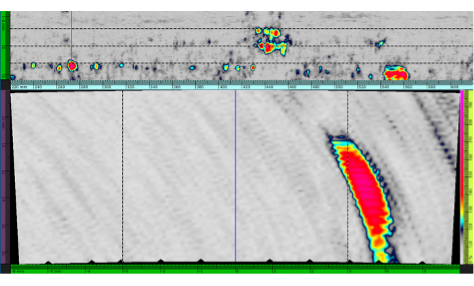
Using the Total Focusing Method to Improve Phased Array Ultrasonic Imaging
The nondestructive testing (NDT) industry is experiencing an important technological advancement, as total focusing method (TFM) capable inspection devices are making their entry into the market. The TFM approach represents a significant step forward for phased array ultrasonic testing (PAUT) technology.
Frequently Asked Questions about Phase Coherence Imaging
What does phase coherence mean?
The phase of an A-scan refers to the frequencies that make up the signal at any given point. Because of the effects of constructive and destructive interference, the A-scan can be described by the phase portion that dictates the signal frequency and an amplitude portion. In phase coherence imaging (PCI)—a variant of total focus method (TFM) imaging—comparing the phase information between A-scans and the level of similarity in their frequency distributions determines the phase coherence. The greater the similarity between the frequency distributions of the A-scans, the higher the level of coherence.
FAQs about the Open File Format NDE
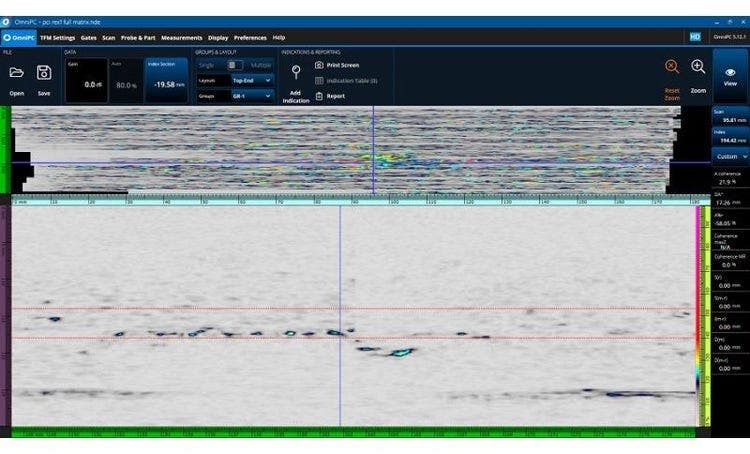
With the release of MXU 5.11 onboard software for OmniScan™ X3 and X3 64 flaw detectors, the file format of data files created with these devices has changed from .odat to .nde. This change is the beginning of a shift in how NDT data is managed and accessed. It starts with the OmniScan X3 series but will be applied to all future Evident nondestructive testing software and hardware platforms, and hopefully it will be extended to and used by the entire NDT industry.
OmniScan™ X3 Phased Array Flaw Detector with Innovative TFM
Confidence You Can See
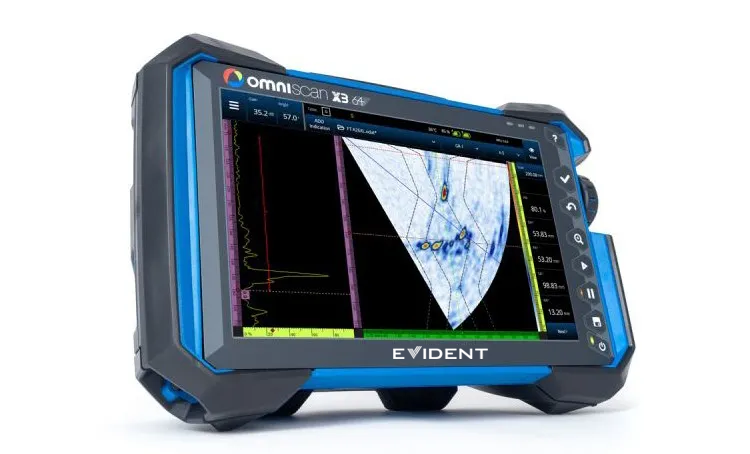
The OmniScan X3 flaw detector is a complete phased array toolbox. Powerful tools, including total focusing method (TFM) imaging and advanced visualization capabilities, backed by its high image quality enable you to complete your inspection with greater confidence.
Innovative and Efficient TFM
Confirm Your TFM Beam Coverage in Advance
The Acoustic Influence Map (AIM) tool provides you with an instant visual model of the sensitivity based on your TFM mode, probe, settings, and simulated reflector.
The AIM tool takes the guesswork out of creating your scan plan—visualize the effect of a wave set (TFM mode), see where sensitivity stops, and adjust your scan plan accordingly.
See What You’ve Been Missing with PCI
Our innovative amplitude-free live phase coherence imaging (PCI) improves small-defect sensitivity and penetration in noisy materials, all while easing your setup and simplifying sizing. Available on the OmniScan X3 64 flaw detector as of MXU 5.10.
Reveal More Details
Benefit from 64-Pulser Phased Array
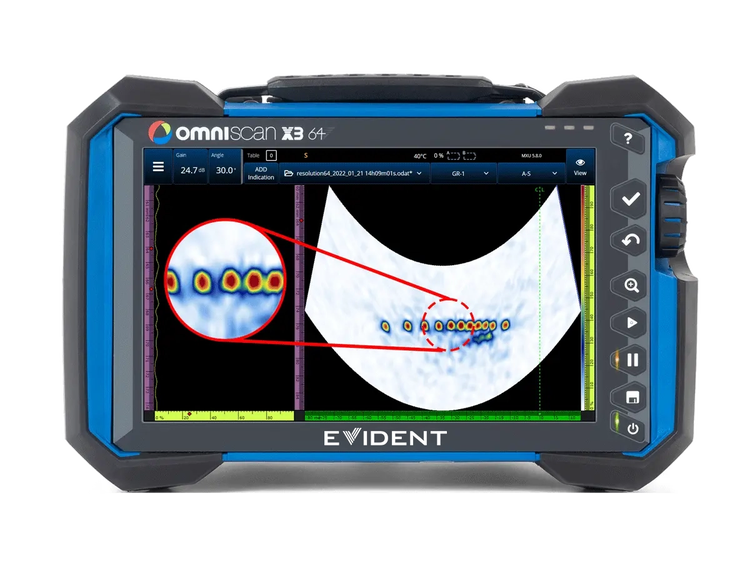
Exploit the full potential of 64-element phased array probes using the OmniScan X3 64 flaw detector to achieve improved resolution at the focal point.
Right-hand image: Acquired using a 32-channel OmniScan X3 unit with a 64-element probe (5L64-A32 model), this S-scan is a high-quality image but the resolution reflects the fact that only the middle 32 elements could be used for the focal law.
Left-hand image: Using a full 64-element aperture (5L64-A32 probe), the OmniScan X3 64 flaw detector provides better PA resolution at the focal point, enabling you to more easily distinguish indications that are close together or in a cluster.
Access Full 128-Element Aperture TFM
Made possible by new generation electronics, TFM imaging offers better focusing capabilities for smaller indications and an improved signal-to-noise ratio (SNR). With its 128-element aperture capacity, the OmniScan X3 64 model provides enhanced image clarity.
Right-hand image: This TFM image was acquired with 64 elements of a 128-element probe (3.5L128-I4 model) using an OmniScan X3 32-channel model.
Left-hand image: Here, the OmniScan X3 64 flaw detector enabled us to use the full 128-element aperture of our 3.5 MHz, 128-element I4 probe. Note the improved resolution and reduced background noise.
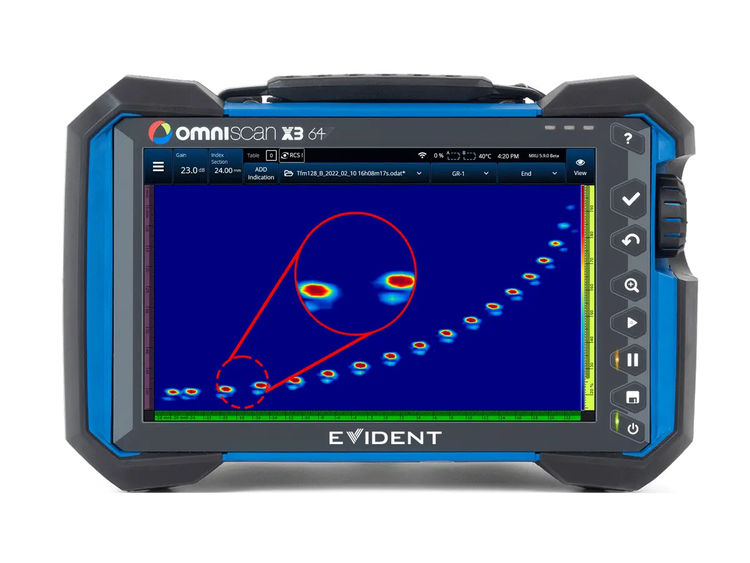
Acquire up to 4X Faster TFM
Achieve total focusing method (TFM) acquisition speeds of up to 4 times faster when using a 64-element probe. Compared to models with 32 pulsers, the OmniScan X3 64 flaw detector offers a significant improvement in efficiency owing to its larger aperture capability.
Improved Phased Array
- Up to 3x as fast as the OmniScan MX2 flaw detector (max pulse repetition frequency)
- Single TOFD menu for an accelerated calibration workflow
- 800% high amplitude range reduces the need to rescan
- Onboard Dual Linear Array™ and Dual Matrix Array™ probe support accelerates setup creation
Ease Corrosion Monitoring Using Phased Array
Using phased array to inspect corrosion offers many benefits, including excellent coverage and resolution. However, becoming proficient in phased array techniques can be challenging. The OmniScan X3 flaw detector combines advanced functions such as gate synchronization with thoughtfully designed software and simplified menus, so you can obtain accurate data more easily. Configure your setup quickly thanks to its A-scan synchronization processing and manual time-corrected gain (TCG).
OmniScan X3 Series
| Models | OmniScan X3 | OmniScan X3 64 | ||
| Configuration | 16:64PR | 16:128PR | 32:128PR | 64:128PR |
| Applications | Corrosion monitoring, Pipeline integrity, Manual PA/TFM, TOFD, Small piping | Multi-group high-productivity thin weld PA & TOFD, Wind blade manufacturing, Composite | Multi-group high-productivity thick weld PA & TOFD, Austenitic/CRA/Disimilar metal weld, TFM | Multi-group high-productivity very thick weld PA & TOFD, Austenitic/CRA/Disimilar metal weld, High-productivity TFM, High Temperature hydrogen attack (HTHA), Advanced application development |
| Pulsers (PA) | 16 | 16 | 32 | 64 |
| Receivers | 64 | 128 | 128 | 128 |
| TFM Elements | 32 | 32 | 64 | 128 |
| UT Channels (P/R) | 2 | 2 | 2 | 2 |
| Groups | Up to 2 (PA, UT/TOFD, TFM) or 2 PA with 1 TOFD |
Up to 8 total TFM: up to 4 |
Up to 8 total TFM: up to 4 |
Up to 8 total TFM: up to 4 |
| Bandwidth Frequency | 0.5 to 18 MHz | 0.2 MHz to 26.5 MHz | ||
| Maximum Pulse Width (PA) | 500 ns | 1000 ns | ||
| Voltage PA | 40 V, 80 V, and 115 V / Unipolar negative | 10 Vpp, 20 Vpp, 40 Vpp, 80 Vpp, 120 Vpp, and 160 Vpp / Bipolar Square Pulse | ||
| Internal SSD Storage Capacity |
64 GB 1 TB |
1 TB | ||
| All Other Features and Specifications | Identical | |||
Service and Support You Can Trust
From calibration to training, we offer a broad portfolio of services to help you maintain optimal device performance. Evident service contracts are:
- Straightforward—so you can focus on the core of your business
- Efficient—we can schedule preventative maintenance, including calibrations, on your behalf
- Cost-effective—providing you savings throughout the life of the contract
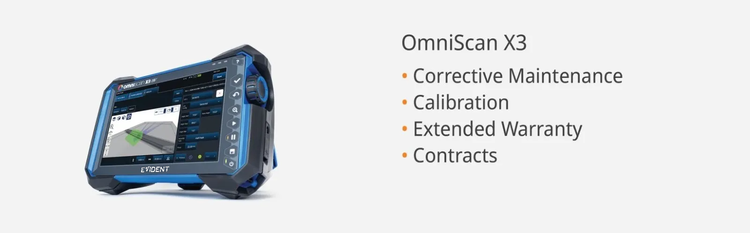
Complete Solutions for Your NDT Workflow
MXU

The OmniScan X3 flaw detector’s MXU onboard software guides you through your inspection workflow.
OmniPC

Our complimentary OmniPC™ computer-based analysis software is compatible with OmniScan X3, OmniScan MX2, and OmniScan SX data files.
WeldSight

WeldSight™ advanced analysis and acquisition PC software is compatible with the OmniScan X3 flaw detector. For increased productivity, the WeldSight Remote Connect app installed on the acquisition unit enables you to perform the entire inspection workflow using WeldSight software.
Applications
Solutions
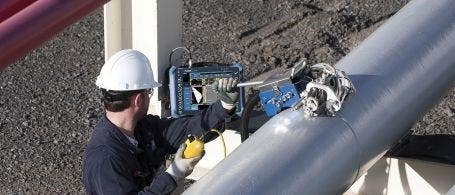
Industrial Scanners
The capacity to accurately position probes according to the surface being inspected greatly influences inspection quality. Evident offers a wide range of industrial scanners and accessories to assist inspectors in their work. Scanners come in various configurations including one or two encoded axes with manual or motorized motion.
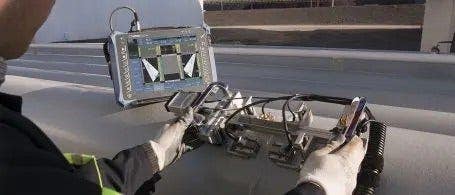
Weld Inspection Solutions
Evident versatile weld solution uses a variety of techniques and scanning tools to achieve a productive and efficient inspection. Phased array, TOFD, and conventional ultrasonic techniques can be used alone or in combination to achieve full-weld coverage with high probability of detection.
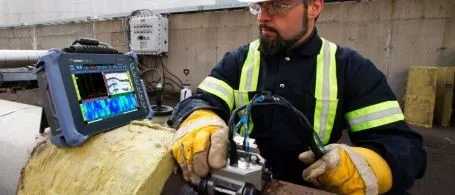
Corrosion Inspection Solutions
Evident has a wide range of innovative products utilizing advanced technologies for the manual or automated inspections of internally corroded pipes and tanks, high-temperature surfaces, corrosion mapping of large pressurized vessels and stress corrosion cracking are typical applications that require either manual or automated inspections.
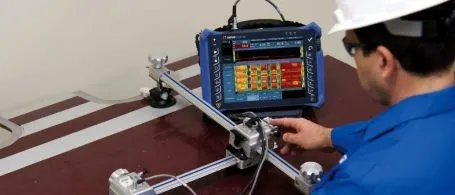
Composite Inspection Solutions
Our composite inspection solutions include portable and integrated inspection instruments that are powerful and fast. Options are available for inspecting several different types of composite and honeycomb parts. Ultrasound and bond testing technologies are packaged with application-specific scanners and probes to address different maintenance or manufacturing industry needs.
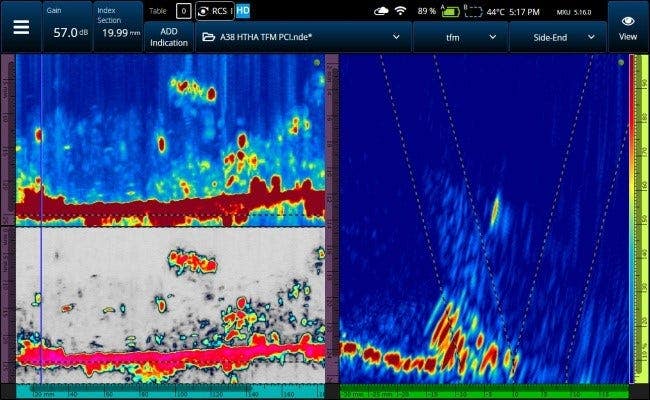
HTHA Inspection Solutions
Confidently detect and define complex damage mechanisms such as high-temperature hydrogen attack (HTHA) through the optimal pairing of Evident’s high-sensitivity multielement probes with the advanced imaging capabilities of our data acquisition instruments.
These reliable solutions provide clear high-resolution images that increase your probability of detection and enable you to perform precise severity assessments to maintain the integrity of your assets.
Onboard Software
MXU

PAUT, TOFD, and TFM Inspection and Analysis Software
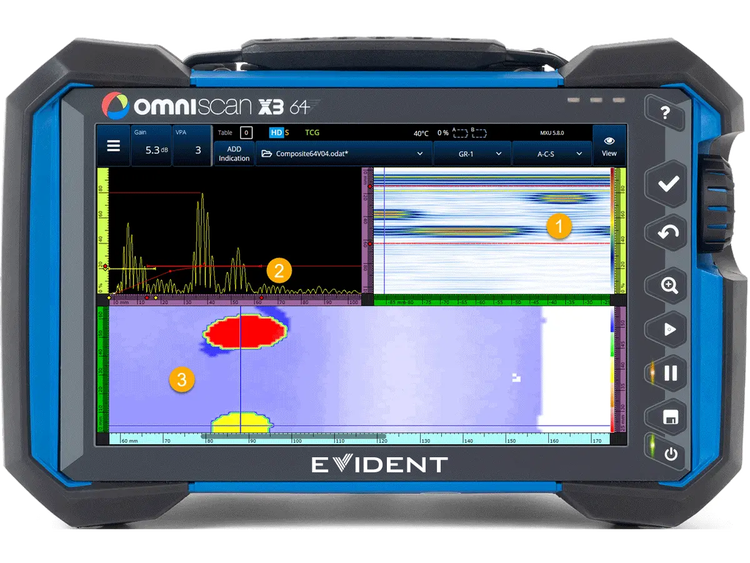
The OmniScan X3 flaw detector’s MXU onboard software provides streamlined, simplified menus and advanced yet intuitive tools to guide you through your inspection workflow using UT, PA, TOFD, and TFM methods, from setup to reporting.
Ease Your NDT Workflow Using Built-In Tools
1. Scan Plan
Follow the steps—1, 2, 3—to set up your inspection on board
2. Calibration
Conduct a fully compliant calibration using the built-in tools
3. Acquisition
View the live scan results during your inspection
4. Analysis
Quickly and confidently interpret your data
Live TFM Envelope Processing
Facilitate Flaw Characterization and Sizing
The instrument’s unique envelope processing provides high-resolution TFM images. Indications look clean and sharp and stand out more clearly against background noise. Up to four TFM modes facilitate interpretation and sizing.
Expand Your PA and TFM Capabilities
Increase your potential to meet the challenges of your customers and develop new procedures for a wider range of applications. Gain the power to drive advanced PA probes such as our Dual Liner Array™ or Dual Matrix Array™ probes or customized probes to achieve higher quailty imaging of acoustically challenging materials.
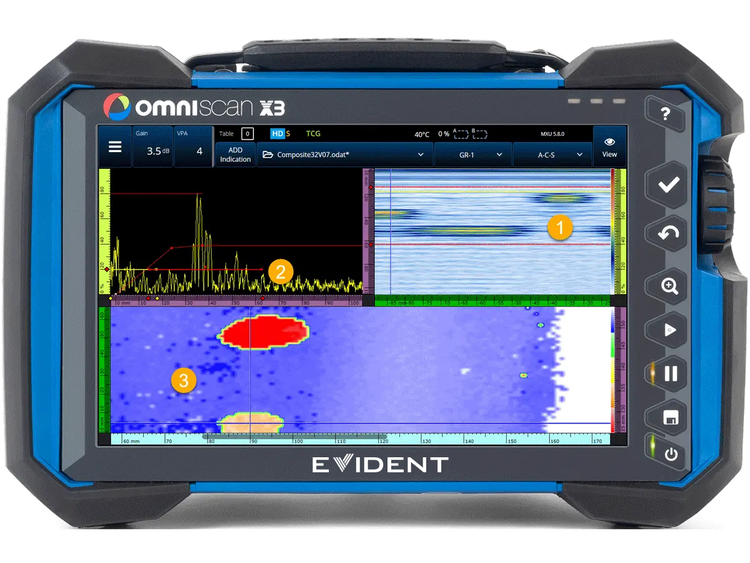
When Precision Is Paramount
See Clearly with Lower Frequencies and Wider Bandwidth
- Versus the 32-channel model, the 64-channel model provides a higher signal-to-noise ratio (SNR) on a larger bandwidth for higher and lower frequencies.
- Capable of driving lower frequencies using a larger pulse width, the OmniScan X3 64 flaw detector offers better signal resolution on attenuative materials such as composites.
- In C-scans, the 64-channel model’s higher resolution and SNR reveal more features in finer detail, enabling you to achieve greater precision when required.
Fix Errors before They Are Made: Improved PAUT and TOFD Data Quality and Reliability
The coupling check channel feature of the OmniScan X3 flaw detector, combined with the ScanDeck™ module’s real-time coupling and scan speed indicators help inspectors monitor data quality before the file is saved.* The coupling quality data is recorded and can be reviewed later.
*The ScanDeck module is available on certain scanners, such as the AxSEAM scanner, as of July 2020.
Avoid Signal Saturation on Large Indications
Easy Gain Adjustment with 800% Amplitude Range
Improve inspection efficiency by eliminating unnecessary rescanning. The high 800% amplitude range enables you to adjust the gain of large indications, such as lack of fusion, to reference level in post processing, avoiding the need to rescan.
Confirm TFM Beam Coverage in Advance
The Acoustic Influence Map (AIM) provides you with an onboard visual model of the sensitivity based on the TFM mode, probe, settings, and simulated reflector. The AIM tool takes the guesswork out of creating your scan plan, enabling you to adjust it accordingly.
Obtain clear data on the projected highest sensitivity area.
See which TFM modes provide the best cover your area of interest.
The higher the Sensitivity Index, the better the expected signal-to-noise ratio (SNR).
Simulate the TFM mode sensitivity on a spherical or planar defect.
Complete OmniScan Retrocompatibility for Your Convenience
Reuse your data files from previous versions of OmniPC software and setup files from OmniScan MX2, SX, and MX flaw detectors. To ease your transition, OmniScan .ops setup files are compatible with the OmniScan X3 flaw detector, and .opd data files are compatible with OmniPC 5 and WeldSight software.
TOFD Lateral Wave Processing
Lateral wave synchronization improves the readability of time-of-flight diffraction (TOFD) data.
- A straighter lateral wave enables more precise depth evaluation and flaw sizing.
- Detect indications closer to the surface, using the lateral wave removal function.
- Lateral wave processing can be done per section, providing better flexibility.
OmniPC 5 Software
Phased Array and Ultrasonic Testing Data Analysis PC Software
OmniPC analysis software is the computer-based companion software for the OmniScan X3 flaw detector. An inspection tool created by inspectors, OmniPC software provides the power and performance to handle all your basic data analysis and reporting needs.
Why OmniPC?
Optimized for NDT Inspectors
Like the on-board software of the OmniScan X3 flaw detector, OmniPC software enables inspectors using UT, PA, TOFD, and TFM to perform efficient analysis and reporting on a PC or laptop.
Complimentary Companion Software for OmniScan Flaw Detectors
OmniPC software is free for download, including updates, by subscribing here:
- No HASP key
- No product key
- No renewal payments
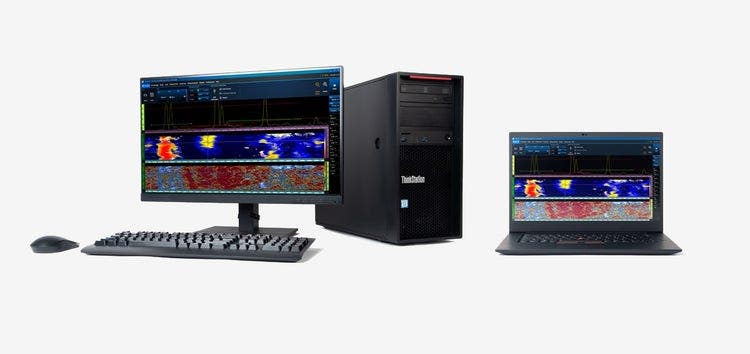
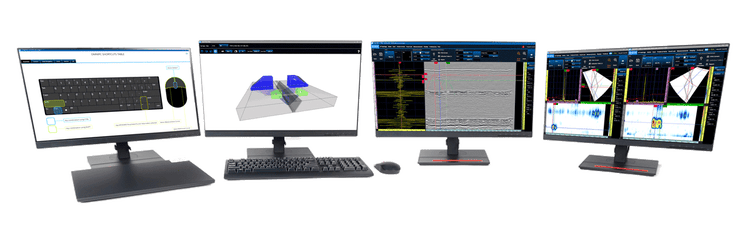
User-friendly features including convenient shortcuts, the flexibility to use different methods, and the ability to open multiple sessions on one computer increase the efficiency your analysis.
Familiar OmniScan User Interface
The user interface of OmniPC software resembles the OmniScan X3 on-board software to ease your learning curve.
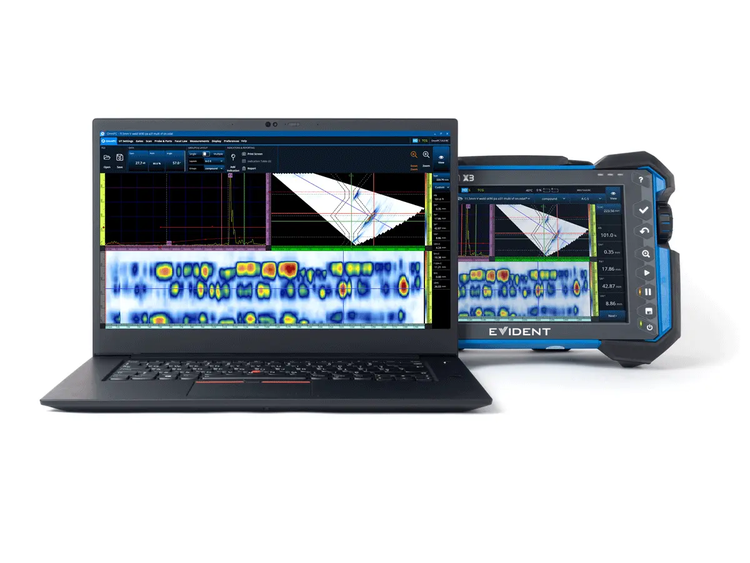
Flexible Tools to Ease Your PAUT and TOFD Data Analysis
Correct Oversights Made during Acquisition
OmniPC software’s Skew, Scan Offset, and Index Offset can be changed during post-inspection analysis to improve data accuracy and avoid reacquisition.
Adjustable Gates and Dynamic Readings
Gates A, B, and I are available with various lists of readings (for corrosion inspections).
Replay the Acquisition
At any time, adjust the Gain, apply the Auto 80%, and slide the Data cursors.
Identify Indications with Ease
Use the gate in True Depth or Sound Path or change the Zoom Palette to locate indications faster.
TOFD Recalibration
Recalibrate your wedge delay and PCS in your TOFD files. Synchronize and remove the lateral wave as required.
Specifications
OmniScan® X3 Series Specifications
These specifications apply to all OmniScan X3 and OmniScan X3 64 models.
| Type | Multigroup, multimode ultrasonic flaw detector |
| Size (W × H × D) | 335 mm x 221 mm x 151 mm (13.2 in. x 8.7 in. x 5.9 in.) |
| Weight | 5.7 kg (12.6 lb) (with 1 battery) |
| Hard Drive Capacity | OmniScan X3 : Internal 64 GB SSD OmniScan X3 64 : Internal 1TB SSD extendable using an external USB drive |
| Storage Devices | SDHC™ and SDXC™ cards or most standard USB storage devices Compatible only with NTFS and FAT32 formats. |
| Max Onboard File Size | 25 GB |
| GPS | Yes (unless specified otherwise for some regions) |
| Alarms | 3 |
| Wireless Connection | Yes – wireless LAN dongle included in the package (model varies according to region) |
| PA Connectors | 1 connector |
| UT Connectors | 4 (2 channels P/R) |
| Certifications | ISO 18563-1:2015 ISO-22232-1:2020 |
| Display | |
| Type | TFT LCD with resistive touch screen |
| Size | 269 mm (10.6 in.) |
| Resolution | 1280 × 768 pixels |
| Number of Colors | 16 million |
| Viewing Angles | Horizontal: −85° to 85° Vertical: −85° to 85° |
| I/O Ports | |
| USB 2.0 | 2 ports (one hidden behind the battery) |
| USB 3.0 | 1 port |
| Video Output | Video out (HDMI) |
| Memory Card | SDHC port |
| Communication | Ethernet |
| I/O Lines | |
| Encoder | 2-axis encoder line (quadrature quadrature direction) |
| Digital Input | 6 digital inputs, TTL |
| Digital Output | 5 digital outputs, TTL |
| Acquisition On/Off Switch | Through the configuration of a digital input |
| Power Output Line | 5 V nominal, 1 A (short-circuit protected), and 12 V output at 1 A |
| External DC Supply | |
| DC-IN Voltage | 15 VDC to 18 VDC (min. 50 W) |
| Connector | Circular, 2.5 mm pin diameter, center-positive |
| Battery | |
| Type | Lithium-ion battery |
| Capacity | 87 Wh |
| Number of Batteries | 2 |
| Life | 5 hours using 2 batteries (hot-swap capable) |
| PA/UT Configuration | |
| Bit Depth | 16 bits |
| Maximum PRF | 20 kHz |
| Frequency | |
| Effective Digitizing Frequency | Up to 100 MHz |
| Display | |
| Refresh Rate | A-scan: 60 Hz; S-scan: 20 Hz to 30 Hz |
| Envelope (echo-dynamic mode) | Yes: Volume-corrected S-scan (30 Hz) |
| A-Scan Height | Up to 800% |
| Synchronization | |
| On Internal Clock | 1 Hz to 10 kHz |
| External Pace | Yes |
| On Encoder | On 2 axes: from 1 to 65,536 steps |
Data Specifications
---
| Processing | |
| Maximum Number of A-Scan Data Points | Up to 16,384 |
| Real-Time Averaging | PA: 2, 4, 8, 16 UT: 2, 4, 8, 16, 32, 64 |
| Rectification | RF, full wave, half wave+, half wave- |
| Filtering | PA channel (OmniScan X3): 8 low-pass, 6 band-pass, and 4 high-pass filters PA channel (OmniScan X3 64): 9 band-pass and 7 high-pass filters UT channel: 8 low-pass, 6 band-pass, and 4 high- pass filters (3 additional filters when configured in TOFD) |
| Video Filtering | Smoothing (adjusted to the probe frequency range) |
| Programmable TCG | |
| Number of Points | 32: One TCG (time-corrected gain) curve per focal law |
| Range | PA (standard): 40 dB per step of 0.1 dB UT: 100 dB per step of 0.1 dB |
| Maximum Slope | PA (standard): 40 dB/10 ns UT: 40 dB/10 ns |
Acoustic Specifications
24 Ω in pitch-catch
100 Ω ± 10% at 9 MHz in pitch-catch
50 Ω in pulse-receive mode
OMNIX3-PATFM16128PR = 16 elements
OMNIX3-PATFM32128PR = 32 elements
OMNIX3-PATFM16128PR = 128 receiving elements
OMNIX3-PATFM32128PR = 128 receiving elements
TFM/FMC
---
Self-tandem: LL-L, TT-T, TT-L, TL-T, LT-T, TTT-TT, and TL-L
64-element extended aperture (32:128PR only)
32-element extended aperture for 16:64PR and 16:128PR
128-element extended aperture for 64:128PR
Operating Environment
---
−20 °C to 70 °C (−4 °F to 158 °F) (with no battery inside)