Overcome Environmental and Accessibility Challenges with Our Latest Advances in Corrosion Inspection


When looking for the best portable nondestructive testing (NDT) tools for inspections in remote or limited-access locations, important criteria include:
- Easy installation and operation
- Reliable and high-quality results
To obtain quality signals during phased array ultrasonic testing (PAUT), it’s imperative to ensure uniform sound transmission into the test component. Good coupling between the probe and part surface is a key factor to achieving this. Before choosing a coupling system for your inspection, you need to consider the condition of the part surface. For heavily corroded and uneven surfaces, a local immersion inspection technique is preferred, but for smooth surfaces, a hard wedge may provide some advantages.
I’ll discuss these surface types and outline the solutions Evident offers for such cases.
Advantages of Local Immersion Techniques
For in-situ maintenance inspections, local immersion scanning systems such as our HydroFORM™ scanner with the I8 phased array probe can provide a solution for consistent coupling. Its low-flow water column with foam gasket conforms to the part and maintain surface coupling, even on curved or irregular test surfaces, such as pipes, tanks, and weld joints. However, as a local immersion system, it requires an external water supply to feed it.
For jobs that are remote or inspection targets that are difficult to access, a constant water flow can be impractical or unavailable. Or, in some special cases, environmental regulations may inhibit the use of free-flowing liquids due to contamination concerns.
What to Do When Water Flow Is a “No-Go”
Can you obtain high-quality data if you don’t have access to a running water supply? The answer is yes! For situations where the surface is relatively smooth and a water supply is an issue, the HydroFORM phased array scanner offers an option that requires minimal couplant. This solution is equipped with the REX2 Dual Linear Array™ (DLA) probe and a carriage system that only needs a very light layer of water, so a spray bottle suffices.
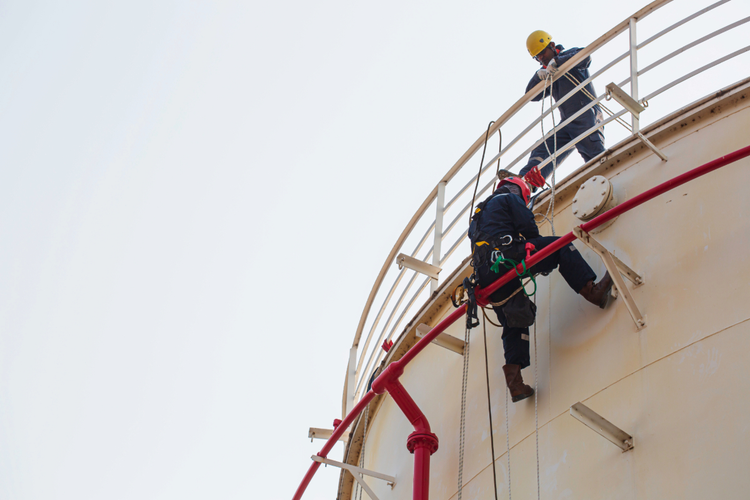
To ease rope-access inspections, the REX2 DLA and HydroFORM solution enable corrosion mapping with minimal couplant.
The REX2 DLA’s spring-loaded mechanism helps keep the probe’s Rexolite delay line in constant contact with the surface, ensuring reliable sound transmission without the need for an external water supply.
Efficient and Versatile Scanning Solution
Featuring an aperture twice the size of the REX1 DLA’s aperture, the REX2 probe offers all the advantages of DLA probes (such as a higher data point density than conventional dual UT transducers), but with additional benefits:
- Increased scanning efficiency due to the larger beam coverage.
- Better probability of detection (POD) due to improved resolution.
- Convenient encoded scanning when combined with the HydroFORM scanner.
Compared with linear probe technology, the DLA’s angled and acoustically insulated transmitting and receiving arrays achieve a smaller focal point closer to the surface of the tested part. As a result, scanning with DLA probes produces imaging results with less stretching of the flaw than with linear phased array probes, which makes sizing accuracy in the scan direction more reliable.
Furthermore, the DLA design minimizes the amplitude of front wall reflections and increases the near-surface resolution, so you’re able to see critical defects closer to the surface.
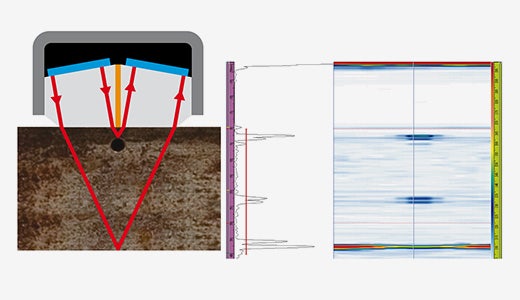
The arrays mounted on an angle in a DLA probe use a pitch-catch technique, minimizing the interface echo and improving the near-surface resolution.
Depending on your application requirements, there are several options you can choose from when ordering a REX2 probe:
- 1° or 5° roof angles (depending on the part thickness)
- Dual 32-element arrays, when your priorities are speed and cost
- Dual 64-element arrays, when imaging and resolution are your top considerations
- For improved coupling on curved surfaces, wedges are available in several AOD curvatures (SREX2 series)
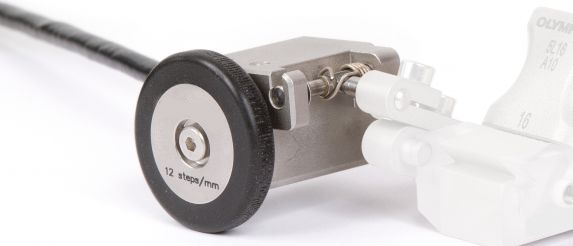
- Choice of carriage or scanner: small carriage with wheels (compatible with the Mini-Wheel™ encoder) or the XY-axis encoding HydroFORM scanner with the ScanDeck™ module.
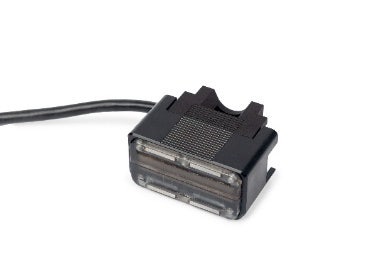
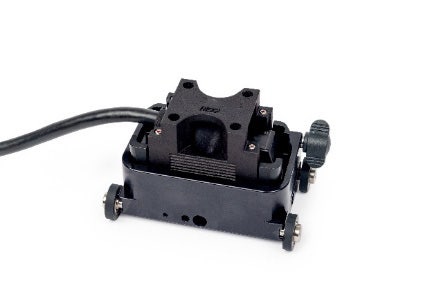
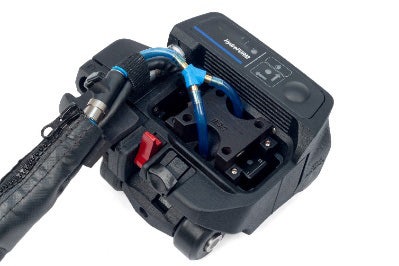
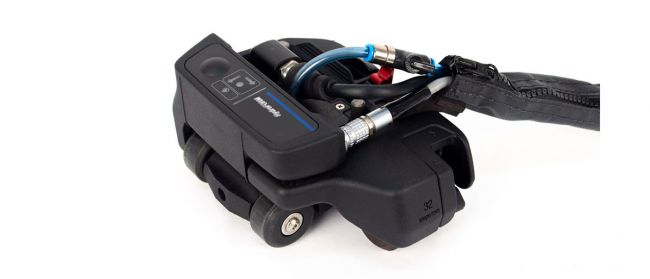
The REX2 DLA probe (left) mounted in the carriage (middle) and installed in the HydroFORM scanner (right). The wheel stabilizers of both systems enable smoother scanning.
Perform Manual, Semiautomated, or Automated Scanning
You can use the REX2 to perform manual scanning with the carriage accessory or incorporate it into the HydroFORM scanner to equipe this semiautomated solution with DLA capabilities.
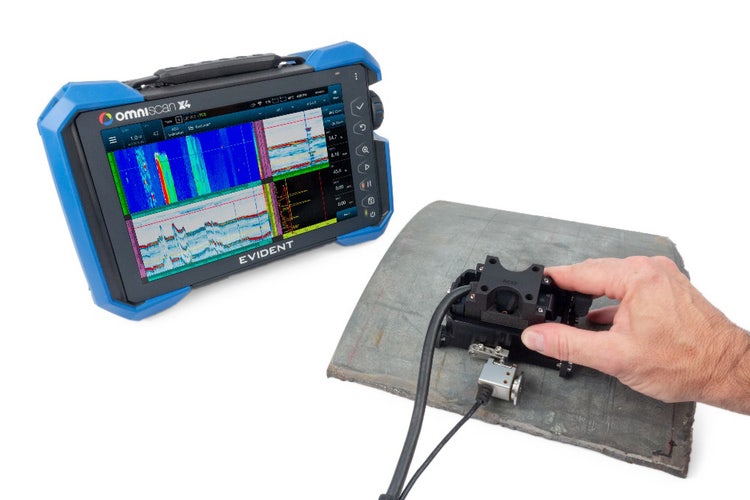
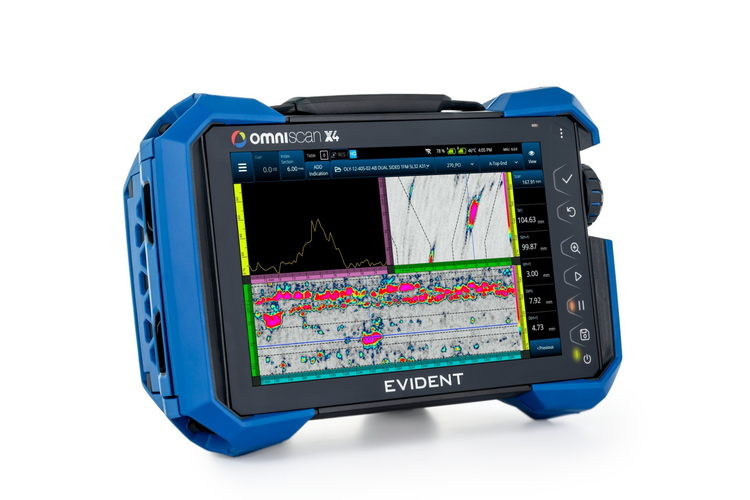
Using the OmniScan X4 flaw detector with the REX2 DLA installed in its carriage with the Mini-Wheel encoder attached.
In addition to the HydroFORM scanner’s XY-axis encoding capacity, features on its ScanDeck module—including a smart indexing button, indexing guidance, coupling check indicator, and scan speed check—ease the job of corrosion mapping, particularly for solo inspectors.
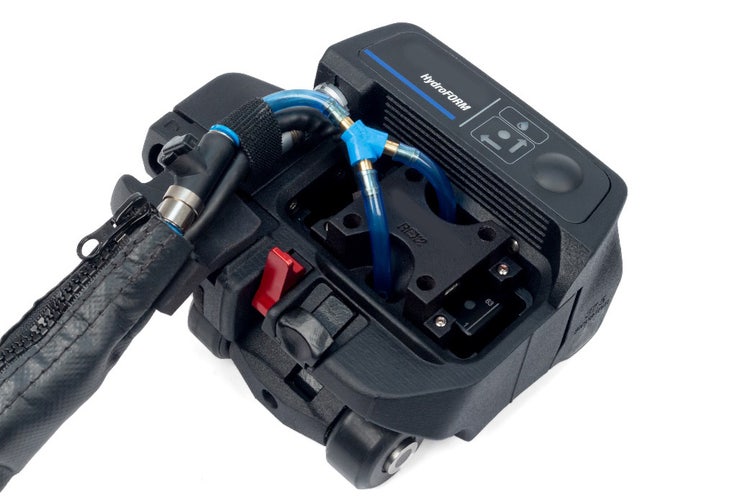
The REX2 Dual Linear Array probe installed in the X-Y encoding HydroFORM scanner with ScanDeck module.
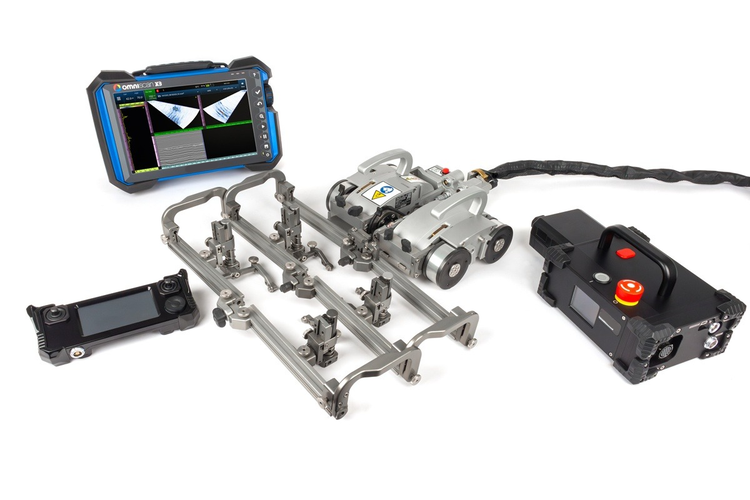
Once installed in the HydroFORM scanner, you can also extend the REX2 DLA to achieve high-throughput automated corrosion mapping by mounting the assembly onto the motorized MapROVER™ scanner for pipe inspection or the SteerROVER™ scanner for remote inspections.
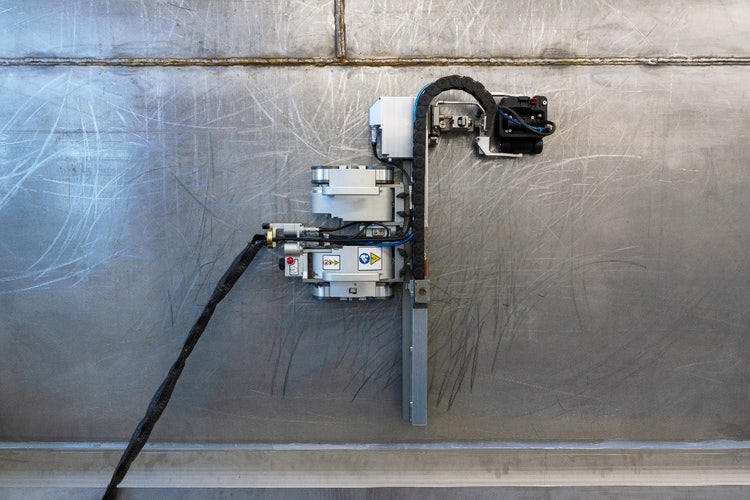
A powerful scanning combination incorporating the HydroFORM and SteerROVER scanners.
Accurately Detect and Measure Challenging Corrosion Mechanisms with TFM and PCI
Like the REX1, the REX2 DLA’s PR wiring is optimized to support the complex focal law demands of the OmniScan X4 flaw detector’s total focusing method (TFM) and phase coherence imaging (PCI).
When equipped with the REX2 DLA, the HydroFORM scanner enables you to perform corrosion mapping that benefits from the capacity of TFM and PCI to provide high-resolution images of typically difficult-to-detect damage, such as pitting or vertically oriented cracks. You can also exploit the high sensitivity of TFM and PCI to reveal complex, smaller pits and flaws such as H2S stepwise cracking (also know as hydrogen-induced cracking, or HIC) that may otherwise go unseen.
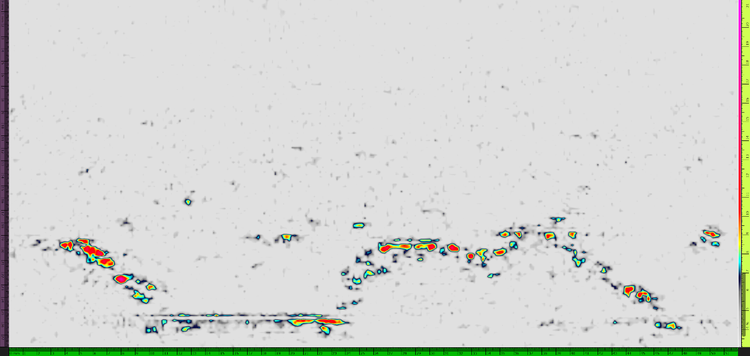
Phase coherence imaging (PCI) of hydrogen induced stepwise cracking (HIC) acquired using the OmniScan X4 flaw detector and HydroFORM scanner with the REX2 DLA probe.
Is the REX2 DLA the Right Tool for Your Inspection?
For inspectors seeking an efficient and easy-to-implement corrosion inspection solution for relatively smooth surfaces, the REX2 is an option to seriously consider. Combined with the HydroFORM scanner and OmniScan X4 flaw detector, the REX2 DLA offers these unique advantages:
- It provides an ideal alternative to local immersion techniques for applications where the use of a water column is inappropriate or impossible.
- It can assist you in applications where near-surface resolution requirements are stricter.
- It enables you to leverage advanced techniques such as TFM and PCI to reveal difficult-to-detect damage mechanisms.
If you are interested in more details, a demo, or a quote, reach out to your local Evident representative or contact us here.
Featured Products

Simon Alain
Director, Global Product Management, Scanners & Solutions
Simon has a bachelor’s degree in science and is the director of the product management team for scanners and inspection solutions at Evident. Since 2007, Simon has overseen the introduction of numerous innovative portable scanning devices and inspection solutions, bringing improved ultrasound data acquisition to the market .